Rio Tinto was never a casual participant in the diamond world. For over four decades, the company built and operated some of the most productive diamond mines on the planet.
Their flagship asset was the Argyle Diamond Mine in Western Australia, which opened in 1983 and ran for 37 years. At its peak, Argyle was the world's largest diamond mine by volume and the source of over 90% of the world's pink diamonds — among the rarest gemstones in existence. When Argyle closed in 2020 after exhausting its ore body, it ended an era for fancy colour diamonds.
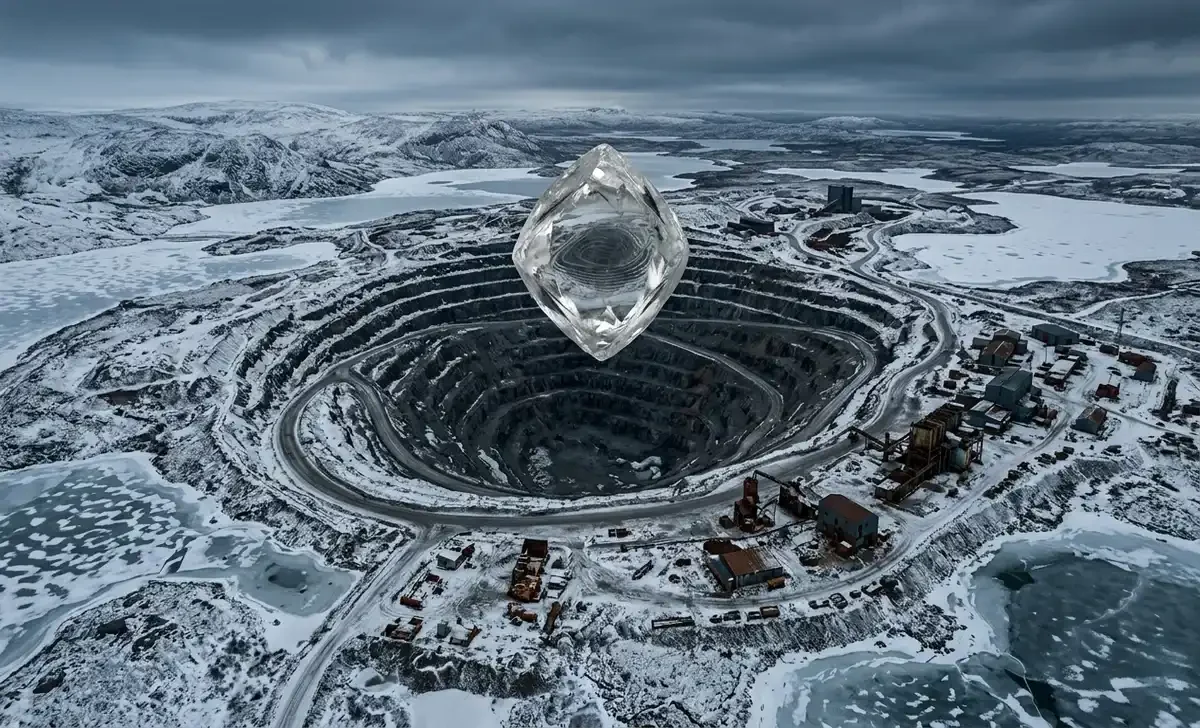
Rio Tinto also held a 60% stake in the Diavik Diamond Mine in Canada, a joint venture with Dominion Diamond Mines. Diavik, which began production in 2003, became known for producing high-quality, gem-grade white diamonds in one of the most remote and challenging environments on Earth — accessible only by ice road in winter or by air year-round.
Together, these two operations made Rio Tinto a genuine powerhouse in diamond supply for over four decades. Their complete exit, therefore, is not a minor footnote. It removes a major, reliable source of certified, traceable, gem-quality diamonds from the global market.
Why Did Rio Tinto Exit the Diamond Industry?
The decision did not happen overnight. Multiple converging pressures made the exit both logical and, ultimately, inevitable.
1. Declining Ore Grades
As any mine ages, the concentration of diamonds per tonne of rock decreases. What once produced high yields at lower extraction costs becomes progressively more expensive to operate as the ore body depletes. Diavik's underground operations were costlier than the earlier open-pit phase, and projections showed diminishing returns over the remaining mine life.
2. Strategic Pivot to Future-Facing Minerals
Rio Tinto has aggressively repositioned its portfolio around copper, lithium, and iron ore — materials central to the electric vehicle boom and the global energy transition. In this context, diamond mining simply does not align with where the company is placing its long-term bets. Capital and management attention are finite, and both were redirected toward commodities with stronger growth trajectories.
3. Lab-Grown Diamond Competition
Perhaps the most disruptive force in the sector has been the explosion of lab-grown diamonds. Chemically and physically identical to mined diamonds, lab-grown stones now sell for 80–90% less than their natural equivalents. When a competitor can undercut your product by that margin while gaining mainstream consumer acceptance — particularly among younger buyers — the economics of maintaining remote, high-cost mines become very hard to defend.
4. ESG and Shareholder Pressure
Environmental, Social, and Governance scrutiny has intensified for all major mining companies. Remote operations with complex rehabilitation obligations attract closer examination from institutional investors. In some cases, these pressures escalate into formal securities litigation when investors feel material disclosures about operational risks or strategic direction have been inadequate. For Rio Tinto, diamonds no longer justified that exposure.
The Diavik Mine: Closure Timeline and What Happens to the Site
Diavik sits on a small island in Lac de Gras, roughly 300 kilometres northeast of Yellowknife. The remoteness that once made it a logistical challenge now makes decommissioning an equally complex undertaking.
Mine closure in Canada is not simply switching off the equipment. It is a structured, multi-year, government-regulated process. Key phases include:
- Water treatment: Ensuring no contamination enters the surrounding lake system, which is both ecologically sensitive and adjacent to Indigenous community watersheds.
- Infrastructure removal: Dismantling processing plants, accommodation camps, airstrips, and the engineered dykes that allowed mining within the lake.
- Tailings management: Safely containing and monitoring the fine-grained mining waste left behind, which requires ongoing attention for years post-closure.
- Ecosystem monitoring: Long-term environmental programmes tracking the recovery of terrestrial and aquatic ecosystems.
- Regulatory sign-off: Final approval from both federal and Northwest Territories authorities before the site is formally released.
Rio Tinto has set aside significant financial provisions for this work — a legal requirement under Canadian mining law. The rehabilitation process is expected to continue for several years beyond the operational closure date.
Impact on Indigenous Communities and Workers
The human dimension of this closure deserves serious attention. Diavik was one of the most significant economic engines in Canada's Northwest Territories, providing direct and indirect employment to hundreds of workers, with a meaningful proportion drawn from local Indigenous communities.
Rio Tinto had formal Impact Benefit Agreements (IBAs) with the Yellowknives Dene First Nation and the Tłı̨chǫ Government, guaranteeing employment, training opportunities, and business contracts tied to the mine's operation. With closure, those agreements — and the income streams they represented — come to an end.
To their credit, responsible mining companies typically plan closures years. Worker transition packages, retraining programmes, and community liaison processes are standard practice at this scale. But the reality for remote communities with limited alternative employers is that no transition programme fully replaces a major mine. The economic impact will be felt for years, and the communities affected deserve sustained attention from both government and industry.
How Rio Tinto's Exit Affects Global Diamond Supply and Prices
The central question for the trade: will natural diamond prices rise?
The honest answer is — yes, over time, for gem-quality natural stones. Here is why.
Rio Tinto was not a fringe producer. They consistently supplied Kimberley Process-certified, traceable, gem-quality diamonds through established industry channels. Removing that supply creates a real gap that remaining producers cannot immediately fill.
The current major natural diamond supply landscape looks like this:
- Botswana (Debswana/De Beers): The world's dominant natural diamond supplier and the most stable source of gem-quality stones.
- Russia (Alrosa): Still the world's largest diamond producer by volume, but Western sanctions have significantly disrupted distribution into European and US markets.
- Angola and Zimbabwe: Growing producers, but not yet operating at the scale or traceability standards needed to fill the supply gap.
- Canada (Ekati): The remaining Canadian operation, but smaller in scale and facing its own operational pressures.
With Rio Tinto removed from the equation, the natural diamond supply is now more concentrated among fewer players. That kind of supply consolidation has broader implications beyond just price — it introduces the type of commodity dependency risks that financial analysts flag when discussing private credit and economic risks in downstream industries that rely on steady natural diamond inventory for purchasing and financing cycles.
However, the moderating factor remains lab-grown diamonds. The market is bifurcating cleanly: natural diamonds for luxury and investment buyers willing to pay significant premiums, and lab-grown for price-conscious consumers. That bifurcation will prevent the kind of dramatic price spikes the market might otherwise see from supply reduction alone.
What Diamond Buyers and Jewellers Should Do Now
Whether you are a retailer, a jeweller sourcing stones, or an individual buyer planning a purchase, this closure has concrete practical implications.
For Retailers and Jewellers
- Expect tighter availability of Diavik-origin stones in certified traceability programmes going forward.
- Canadian-origin diamonds — a compelling marketing story for ethical provenance — will become meaningfully scarcer, which strengthens their narrative value for the stones already in circulation.
- Argyle pink diamonds, already extremely rare since the 2020 closure, are now confirmed collectibles. If you hold inventory, it carries genuine long-term appreciation potential.
- Independent jewellers and women-owned businesses who have built brand identity around ethically traceable natural stones will need to work harder to source equivalents — building relationships with smaller certified producers in Botswana or Angola is worth exploring now rather than reactively.
For Individual Buyers
- If you are buying a natural diamond for jewellery or investment, the supply backdrop is tightening. Buying quality now is a sounder strategy than waiting for prices to fall — that trajectory has reversed.
- Certified provenance documentation (country of origin, chain of custody) will carry increasing premium value as traceable supply shrinks. Prioritise GIA or AGS certification.
- Lab-grown remains the smart choice if budget is the primary driver. But for heirloom or investment purposes, natural still holds the stronger long-term case — particularly for fancy colour stones.
Lab-Grown Diamonds: Disruptor, Not a Passing Fad
Any honest analysis of Rio Tinto's exit must address lab-grown diamonds directly. Over the past five years, production — primarily from India and China — has scaled dramatically, pushing retail prices down by 80–90% compared to natural equivalents.
Consumer acceptance, particularly among buyers under 40, has moved faster than many industry veterans expected. The value proposition is straightforward: identical chemical and physical properties, a cleaner ethical story (no land disruption, no conflict supply chain concerns), and significantly lower cost.
Did lab-grown diamonds directly cause Rio Tinto to exit? Not in isolation. But they absolutely eroded the economic justification for maintaining expensive, remote, high-cost natural diamond operations. When your product faces a competitor that undercuts you by 80% and is gaining mainstream acceptance, every high-cost mine on your balance sheet looks less defensible.
The important insight for the market: lab-grown is not a temporary disruption that will self-correct. It is a permanent structural feature of the diamond landscape. The natural diamond sector's future lies in differentiation — rarity, provenance, emotional significance, and investment value — not volume competition.
FAQs
Why did Rio Tinto close its diamond mine?
Rio Tinto closed its last diamond mine due to a combination of declining ore grades at the Diavik operation, a strategic pivot toward copper, lithium, and iron ore, and sustained economic pressure from lab-grown diamonds that significantly compressed natural diamond margins. The closure completes a full exit from the diamond sector that began with the Argyle closure in 2020.
Which was Rio Tinto's last diamond mine?
Rio Tinto's last operating diamond mine was the Diavik Diamond Mine in Canada's Northwest Territories, where it held a 60% ownership stake. Diavik produced gem-quality white diamonds from 2003 until its operational closure.
Will Rio Tinto's mine closure cause diamond prices to rise?
For natural gem-quality diamonds, yes — over the medium to long term. Supply is becoming more concentrated and tighter. However, lab-grown diamond competition and existing market inventory will prevent immediate dramatic price increases. The most significant price appreciation is expected for traceable, certified natural stones and fancy colour diamonds.
What happened to the Argyle diamond mine?
The Argyle Diamond Mine in Western Australia, which supplied over 90% of the world's pink diamonds, closed in 2020 after its ore body was fully exhausted. The Diavik closure now completes Rio Tinto's full exit from diamond mining globally.
Are lab-grown diamonds worth buying?
For jewellery purposes, lab-grown diamonds offer excellent value — identical optical and physical properties at 80–90% lower cost than natural equivalents. For investment or heirloom purposes, natural diamonds, particularly fancy colour stones from closed mines like Argyle, hold stronger long-term appreciation potential due to finite and shrinking supply.
What does this mean for Canadian-origin diamonds?
Canadian-origin diamonds have long commanded a premium based on their ethical sourcing story — mined under strict environmental regulations with community benefit agreements. With Diavik now closed, Canadian diamond supply will shrink considerably, making existing Canadian-origin stones more valuable from both a provenance and scarcity standpoint.