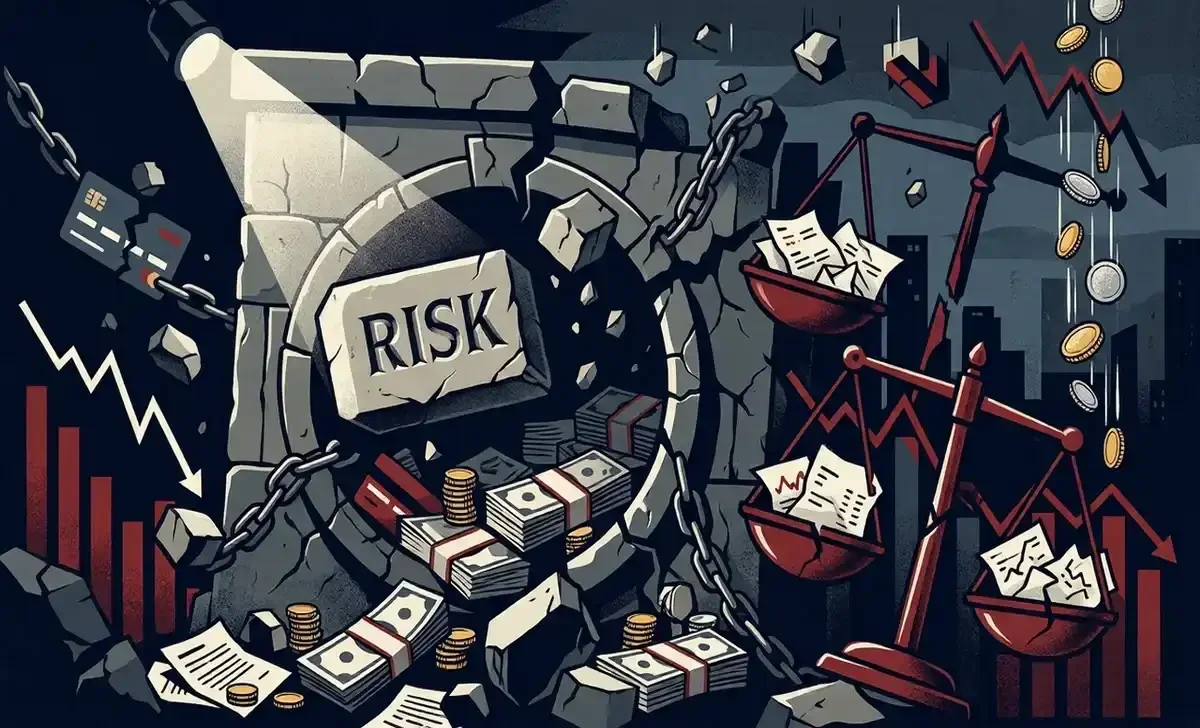
Private credit has quietly become one of the most consequential forces in modern finance. What started as a niche alternative to bank lending has grown into a $1.7 trillion global industry — and it now touches the retirement savings of millions of people who have never heard the term "direct lending" in their lives.
Pension funds, insurance companies, sovereign wealth funds, and family offices have poured capital into private credit strategies, drawn by yields that public bond markets simply cannot match. On the surface, this looks like a win for everyone: businesses get flexible financing, investors get higher returns, and the broader economy gets a new source of credit outside the traditional banking system.
But private credit economy risk is real, growing, and deeply misunderstood — even by many of the institutional investors now most exposed to it. Unlike public markets, private credit operates without daily pricing, transparent secondary markets, or meaningful real-time oversight. As interest rates remain elevated and cracks begin appearing in leveraged portfolios, understanding exactly where the risks lie has never been more urgent.
This guide breaks down every major risk category in private credit — with real examples, practical investor tips, and the specific questions you should be asking before allocating a single dollar.
What Is Private Credit? A Quick Primer
Private credit refers to debt financing arranged directly between a lender (typically a specialist fund) and a borrower (typically a mid-market company), without going through a public exchange or a traditional bank. Because these instruments aren't publicly traded, lenders can charge a meaningful yield premium for the illiquidity and complexity they're taking on.
The main strategies within private credit include:
- Direct lending — senior secured loans to private equity-backed businesses
- Mezzanine debt — subordinated debt with equity-like upside
- Distressed credit — buying discounted debt in troubled companies
- Real estate debt and infrastructure debt — loans secured against physical assets
- Venture debt — loans to early and growth-stage companies
The appeal is straightforward: yields of 10–14% compared to 5–6% on investment-grade public bonds. But that yield premium compensates for a very specific set of risks — and those risks are what we need to examine carefully.
1. Illiquidity Risk: The Lock-Up Problem
Illiquidity is the most fundamental private credit economy risk, and it is also the most consistently underestimated by first-time allocators.
When you invest in a private credit fund, your capital is typically locked up for five to ten years. There is no secondary market you can easily access. If you need capital during a downturn, if a portfolio company starts missing payments, or if market conditions deteriorate, your options are very limited.
The risk has intensified as private credit has expanded into retail channels through semi-liquid "interval fund" structures. These vehicles promise periodic redemptions — typically quarterly — but if too many investors attempt to exit simultaneously, fund managers may be forced to either sell assets at distressed prices or gate withdrawals entirely.
Real-world precedent: In 2022–2023, several non-traded REITs, including Blackstone's BREIT, imposed withdrawal limits as redemption requests exceeded available liquidity. Private credit interval funds face structurally similar mismatches between investor expectations and underlying asset liquidity.
Key questions for any investor:
- What exactly triggers a gate or suspension of redemptions?
- How much of the fund's assets can be liquidated within 90 days at fair value?
- What percentage of your portfolio can you genuinely afford to lock up for a decade?
2. Valuation Opacity: The "Mark-to-Fantasy" Problem
Public bonds are priced every second by active markets. Private credit loans are valued quarterly — typically by the fund manager themselves, or by a third-party appraiser they select and compensate.
This creates a structural conflict of interest. Fund managers who report stable or rising valuations attract continued capital inflows, while competitors showing write-downs lose investors to those prettier numbers. Critics have called this practice "mark-to-fantasy" — maintaining optimistic valuations long after the underlying credit quality has deteriorated.
The IMF and the Federal Reserve have both flagged this explicitly as a systemic concern. In practice, what it means is that private credit funds often show remarkably smooth performance during market stress — not because their portfolios are genuinely performing, but because reality hasn't yet been forced into a quarterly mark.
What happened in practice: Several European direct lending funds reported relatively benign quarterly marks throughout 2022, only to recognize significant write-downs in 2023–2024 when leveraged buyout-backed portfolio companies couldn't refinance at elevated rates. The losses didn't appear gradually — they arrived all at once.
3. Credit Quality Deterioration
As private credit grew from roughly $400 billion to $1.7 trillion in under a decade, an enormous amount of capital needed to be deployed. Fund managers under fee pressure to put money to work sometimes relaxed underwriting standards to source enough deals.
The result is that a significant portion of today's private credit portfolios consists of loans to heavily leveraged, middle-market companies with thin margins, cyclical revenues, and limited financial flexibility. Many of these borrowers are private equity-backed businesses acquired at peak valuations with debt structures that made sense at 2% base rates but look precarious at 5%+.
One of the clearest warning signs is the growing prevalence of payment-in-kind (PIK) amendments — arrangements where struggling borrowers defer cash interest by adding it to the outstanding principal balance. PIK usage is not inherently problematic, but a fund with rising PIK concentrations is quietly accumulating credit stress that doesn't show up in reported yields.
Some stressed mid-market borrowers have responded by exploring unconventional competitive strategies — including coopetition approaches designed to preserve cash flow and market position under heavy debt burdens. Strategic creativity can buy time, but it rarely resolves fundamentally over-leveraged capital structures.
4. Interest Rate Sensitivity and Borrower Stress
The floating-rate structure of private credit loans was widely marketed as an advantage for lenders in a rising-rate environment — and initially, it was. Yields on direct loans climbed from 7–8% to 12–14% as central banks tightened policy aggressively.
But every basis point that boosted lender yields simultaneously squeezed borrower cash flows. Companies that borrowed heavily to fund acquisitions or operations are now paying far more in debt service than their original business plans projected. Interest coverage ratios — the key measure of a borrower's ability to service debt from operating cash flow — have compressed dramatically across the private equity-backed universe.
At the macro level, this creates a slow-motion drag on the broader economy: businesses cut headcount, reduce capital expenditure, and defer expansion plans to service elevated debt loads. A large enough wave of these decisions, played out across hundreds of PE-backed companies simultaneously, represents a meaningful headwind to GDP growth — one that is largely invisible until it isn't.
5. Systemic Contagion Risk
The standard defense of private credit is that because loans aren't publicly traded and aren't held by regulated banks, they cannot trigger contagion the way 2008-era mortgage securities did. That argument is becoming harder to sustain.
Insurance companies now hold significant private credit allocations to match long-duration liabilities. Pension funds have allocated heavily to boost returns in a low-yield world. If a major private credit manager faces a wave of defaults and marks down assets sharply, those losses flow directly onto the balance sheets of insurers and pension funds — institutions whose obligations extend to millions of retirees.
There is also a less-discussed bank interconnection channel. Private credit funds frequently borrow from banks through subscription credit lines and NAV facilities to amplify returns. In a stress scenario, if banks simultaneously tighten lending to these funds — as they plausibly would — private credit managers could face pressure precisely when their portfolio companies most need additional support.
6. Covenant Erosion: The Early Warning System That No Longer Works
Early-vintage direct lending was characterized by robust maintenance covenants — financial ratio requirements that gave lenders contractual leverage to intervene at the first sign of borrower distress. If interest coverage or leverage metrics slipped, lenders could demand repayment, renegotiation, or board representation.
Competitive pressure for deal flow has stripped most of those protections away. "Covenant-lite" structures now dominate the market. Borrowers can operate in financial distress for extended periods without triggering any formal default mechanism, which means lenders often learn about deteriorating credit quality very late — when the business has already consumed much of its remaining value.
Recovery rates on covenant-lite defaults are structurally lower than on covenant-heavy loans, because the intervention point comes much later in the deterioration cycle.
7. Concentration and Hidden Correlation Risk
Many private credit funds present themselves as diversified across industries and borrowers. In practice, deal flow in direct lending concentrates heavily around a handful of sectors — most commonly enterprise software, healthcare services, and business process outsourcing — and almost exclusively around private equity sponsor-backed transactions.
This means that apparent diversification across fund names may mask substantial underlying correlation. When enterprise SaaS companies face multiple contractions, or when healthcare reimbursement rates are cut, loans across multiple "diversified" funds deteriorate simultaneously. The correlation that was invisible in a benign macro environment becomes obvious — and painful — in a downturn.
8. Regulatory and Compliance Gaps
Private credit operates in a meaningful regulatory gray zone. Unlike banks, private credit funds are not subject to Basel capital requirements, stress testing mandates, or deposit insurance frameworks. This regulatory arbitrage partly explains how private credit grew so rapidly — it could take on risk concentrations that banks were no longer permitted to hold post-2008.
The SEC has tightened reporting requirements for large private fund managers in recent years, and the Financial Stability Board has published guidance on systemic risks in non-bank financial intermediation. But the data infrastructure for monitoring systemic private credit exposure globally remains significantly underdeveloped relative to the scale the market has now reached.
As default rates rise and distressed restructurings increase, securities litigation exposure for fund managers and their institutional investors is also growing — an underappreciated legal dimension of this regulatory blind spot that is beginning to surface in real cases.
9. Manager Inexperience Across the Credit Cycle
When a market generates strong returns, new entrants flood in. Private credit has attracted hundreds of new fund managers over the past decade — many of whom have never managed a portfolio through a genuine credit cycle downturn.
The last serious private credit stress event was 2008–2009. Managers who built their entire track records during the 2010–2021 period of near-zero rates, abundant liquidity, and minimal defaults have simply never managed distressed workouts, creditor-in-possession financing, or contested bankruptcy processes at scale.
Navigating troubled credit is a distinct operational skill — one that requires legal expertise, operational restructuring capability, and experience making difficult decisions when companies are failing. Managers who lack this background will make costly mistakes when their portfolios hit turbulence, hurting both investors and the underlying businesses.
10. Geopolitical and Macroeconomic Shock Risk
Private credit portfolios are built on underwriting assumptions that embed forecasts about macro stability — supply chain reliability, consumer demand trajectories, regulatory environments, and currency regimes. Geopolitical shocks can invalidate those assumptions quickly and without warning.
Unlike publicly traded debt, where prices adjust in real time as macro conditions shift, private credit portfolios absorb shocks silently until the next quarterly valuation cycle. By the time losses are recognized, the underlying damage has often already compounded.
The closure of Rio Tinto's Argyle diamond mine is an instructive example of how swiftly macro and resource-driven forces can render previously sound asset assumptions obsolete — a dynamic that translates directly to private credit portfolios with exposure to commodity-linked or capital-intensive industries. For businesses in import-dependent sectors or those reliant on cross-border supply chains, tariff escalations and currency dislocations represent genuine credit risks that many pre-2020 loan underwriting models did not adequately price.
Practical Tips for Investors Allocating to Private Credit
- Stress-test the liquidity terms in writing. Ask fund managers exactly what triggers gates or redemption suspensions — and get the answer documented, not just stated verbally in a pitch meeting.
- Request borrower-level portfolio data. Top-line IRR and MOIC figures tell you very little. Ask for leverage multiples, interest coverage ratios, PIK concentrations, and amendment history across the portfolio.
- Diversify across managers and fund vintages. Concentration in a single manager or a single deployment year compounds vintage risk significantly.
- Understand PIK income carefully. A fund reporting high yields that include significant PIK income is deferring cash collection, not earning it. This is not equivalent to a fund collecting full cash interest.
- Ask specifically about workout experience. Request case studies of distressed situations the team has actually navigated through — not hypothetical frameworks, but real outcomes from real defaults.
- Check fund-level leverage. Many funds use subscription credit lines and NAV facilities. Understand the gross vs. net leverage of the vehicle before interpreting return figures.
Common Mistakes to Avoid
- Chasing yield without understanding the underlying credit. A 14% yield on a loan with a 1.1x interest coverage ratio declining quarter-over-quarter is not attractive — it is a distress signal priced as a premium.
- Treating private credit as a bond substitute. The illiquidity profile, opacity, and leverage of private credit loans make them fundamentally different from investment-grade public bonds, regardless of how they are categorized in an asset allocation framework.
- Assuming stable NAVs mean stable credit quality. Quarterly marks managed by fund managers are not independent price discovery. They are a lagging indicator at best.
- Ignoring macro sensitivity in portfolio construction. Deals underwritten at 0% rates with optimistic growth assumptions do not automatically restructure themselves when rates hit 5%. The gap has to be absorbed somewhere.
FAQs
Is private credit riskier than public bonds?
Private credit typically carries higher credit risk, significantly less liquidity, and less pricing transparency than investment-grade public bonds. The higher yields compensate for these additional risks. For investors who genuinely understand and can tolerate them — and who have the right liquidity profile — private credit can still play a valuable portfolio role. But it should never be treated as a simple substitute for public fixed income.
Can private credit cause a broader financial crisis?
At its current scale, private credit alone is unlikely to trigger a 2008-scale systemic event. However, its interconnections with insurance companies, pension funds, and bank credit lines mean that a severe stress event could transmit losses broadly across the financial system. Regulators globally are increasingly focused on this channel, though oversight frameworks remain underdeveloped relative to the market's current size.
What is the single biggest private credit risk right now?
Most analysts point to the combination of deteriorating borrower credit quality and sustained elevated interest rates. Floating-rate borrowers who took on debt at near-zero base rates are now servicing that debt at dramatically higher costs. The resulting cash flow compression — playing out across hundreds of private equity-backed mid-market companies simultaneously — is the most pressing near-term concern in the asset class.
How should individual investors approach private credit?
Most individual investors should access private credit only through well-diversified, professionally managed vehicles with demonstrated track records across full credit cycles — including the 2008–2009 stress period. Allocation size should reflect genuine illiquidity tolerance rather than yield appetite. Starting with established, larger managers with deep workout capabilities is the more prudent entry point.
Are regulators doing enough about private credit risks?
Regulatory frameworks are improving incrementally but remain behind the pace of market growth. The SEC has expanded reporting requirements for large private fund managers, and international bodies like the FSB have published systemic risk guidance. But the data infrastructure required to monitor private credit exposures at a systemic level globally is still meaningfully underdeveloped compared to banking regulation, and the market continues to grow faster than the oversight infrastructure.