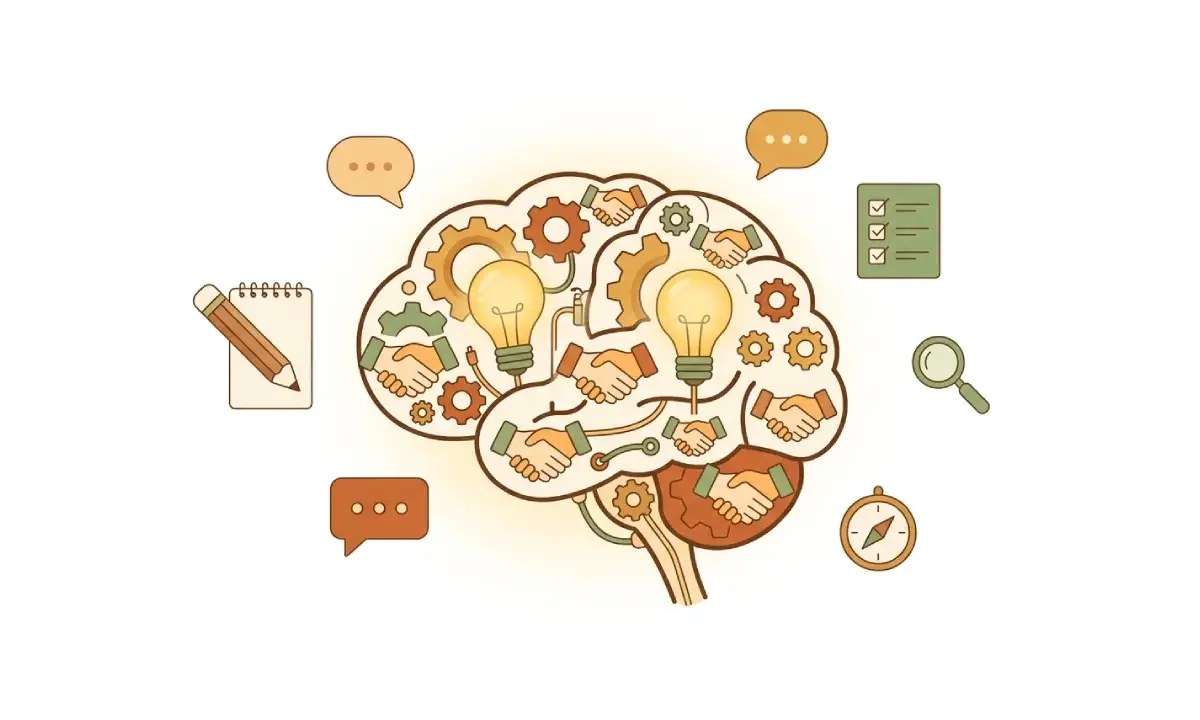
Most people hear "innovation" and picture a startup founder pitching an app, or engineers training AI models in a Silicon Valley lab. It's an understandable assumption — but it's wrong.
Some of the most transformative business shifts in history came from a change in thinking, a smarter way of organizing people, or a better process nobody had tried before. No code. No hardware. No algorithm.
If your team feels it can't truly innovate because you lack budget, technical talent, or the latest tools, this guide is for you. We'll explain what innovation without technology actually means, diagnose why businesses overlook it, and give you 10 practical, proven methods you can apply starting this week.
What Does "Innovation Without Technology" Actually Mean?
Innovation is not a synonym for technology. The Oxford dictionary defines innovation simply as "a new method, idea, or product." No mention of software. No mention of machines.
Innovation without technology means creating real, measurable value through:
- Improved processes and workflows
- New business models or pricing structures
- Better customer experiences
- Smarter organizational structures
- Creative problem-solving frameworks
Toyota's Kaizen system — one of the most copied management philosophies in the world — changed global manufacturing. It was powered by a mindset, not a machine. Offering customers a money-back guarantee was once a radical retail innovation. No technology involved. Just creative thinking applied to a real problem.
The best non-tech innovations are also the hardest for competitors to copy. You can replicate software. You can't easily replicate a deeply embedded culture or a uniquely designed business model.
Why Businesses Overlook Non-Tech Innovation (And Pay for It)
Before diving into methods, it's worth understanding why this kind of innovation gets ignored:
- Shiny object syndrome: New tools feel like progress, even when they don't solve the core problem.
- Measurement bias: Tech investments are easy to justify with dashboards. Cultural shifts are harder to quantify.
- Prestige framing: "We launched a new app" sounds better at conferences than "we redesigned our onboarding process."
The result? Businesses pour money into software subscriptions while the real bottlenecks — poor communication, misaligned incentives, broken workflows — go untouched for years.
10 Proven Ways to Innovate Without Technology
Rethink Your Internal Processes
Process innovation is one of the most underrated and lowest-cost forms of improvement available to any organization.
Most teams follow routines established years ago that nobody has ever questioned. That's exactly where the opportunity hides. A process that made sense when you had 5 employees may be creating serious drag at 50.
Real example: A small bakery in London cut bread waste by 40% by simply changing the order in which staff rotated daily tasks. No new equipment. Just a different sequence.
Where to start:
- Map every step of your three most important workflows end-to-end
- Ask frontline workers: "What slows you down the most?" They see what managers miss
- Identify steps that create delay but add no customer value
- Test one small change at a time, measure the impact, then move to the next
The goal is not a dramatic overhaul. It's removing friction — one small step at a time.
Redesign the Customer Experience
Your customers' experience is one of the most fertile grounds for non-tech innovation — and most businesses barely scratch the surface.
The right question isn't "what technology can we add?" It's "where are our customers frustrated, confused, or underwhelmed?"
Real example: A restaurant in Tokyo redesigned its entire menu layout after realizing customers took too long to decide what to order. No new kitchen equipment was purchased. Table turnover improved by 25% and customer satisfaction scores climbed.
How to start:
- Walk through your customer journey from first touchpoint to post-purchase follow-up
- Map emotional high and low points at each stage
- Talk directly to unhappy customers — their feedback is a goldmine most businesses ignore
- Train staff to handle complaints with genuine empathy and enough autonomy to resolve them on the spot
Customer experience innovation comes down to listening more carefully than your competitors. That's a human skill, not a technological one.
Build a Culture of Creative Problem-Solving
Innovation doesn't come from an "ideas meeting" once a quarter. It comes from a culture where people feel safe speaking up, experimenting, and occasionally failing without consequence.
Building that culture is itself a form of innovation — and it requires zero budget.
Google's famous "20% time" policy, where employees could dedicate a portion of their week to side projects, wasn't built on software. It was built on trust and a management philosophy. Some of Google's most-used products emerged from that policy alone.
It's also worth noting that the most enduring innovation cultures are built on intrinsic motivation. Research into fulfillment beyond material achievement consistently shows that people do their most creative work when driven by purpose — a powerful reminder that the human element sits at the core of any lasting innovation culture.
Practical steps:
- Reward ideas openly — even ones that don't work out
- Remove the phrase "that's not how we do things" from your team's vocabulary
- Run short, structured "problem-solving sprints" around a single real challenge
- Create psychological safety: people innovate when they don't fear judgment
Innovate Your Business Model
Sometimes the product stays the same. What changes is how you sell it, who you sell it to, or what you charge for it.
Business model innovation has transformed entire industries — and it rarely starts as a technology idea.
- Gillette didn't invent a better razor. They invented selling razors cheaply and profiting from replacement blades.
- Netflix didn't invent movies. They changed how people paid for and accessed them.
- Michelin gave away restaurant guides to sell more tires — because people needed to drive far enough to wear them out.
As you explore new models, it's worth understanding the broader financial environment your decisions sit within. Shifts such as the growing influence of private credit and the risks it introduces to the wider economy can quietly affect customer purchasing power and access to capital — factors that should inform how you structure and price your offering.
Questions to explore:
- Could we offer a subscription instead of a one-time purchase?
- Is there a customer segment we've been systematically ignoring?
- What if we charged per outcome instead of per hour?
- Could we partner with a complementary business to expand reach?
Business model innovation is the kind of shift that can 10x a company's growth without building a single new product.
Collaborate Across Industries
No organization has all the answers. Some of the best innovations happen at the intersection of two very different industries, skill sets, or perspectives.
Real example: A hospital in the United States partnered with a hotel chain to redesign its patient admission experience. Doctors provided clinical expertise. Hotel staff contributed hospitality knowledge. The result was a dramatically improved patient journey — built from two worlds colliding productively.
How to collaborate for innovation:
- Look outside your industry for solutions to your problems (aviation borrows from Formula 1; hospitals borrow from aviation)
- Build partnerships with organizations whose strengths complement your gaps
- Create internal cross-functional teams — mix departments that rarely interact
- Invite customers or suppliers to co-create solutions with you
The most valuable perspective is usually the one you don't already have in the room.
Repackage What You Already Offer
"Packaging" here doesn't mean boxes and labels. It means how you present, bundle, and deliver what you offer — and it's one of the most underused levers in small business.
Real example: A management consultant who packaged her services as a flat-rate "clarity sprint" — a two-day intensive session with a defined outcome — tripled her revenue compared to charging hourly. Same expertise. Different packaging.
Ideas to explore:
- Bundle individual products into solution-based packages
- Offer tiered service levels (Good / Better / Best)
- Rename offerings to communicate the outcome rather than the process
- Change your delivery format — in-person vs. online, group vs. individual, self-serve vs. guided
Small packaging changes can dramatically improve both conversions and customer satisfaction without touching the underlying product.
Social Innovation: Rethink Who Solves the Problem
Not all innovation is about profit. Social innovation means finding new ways to solve social problems — and some of the most remarkable examples involve no technology at all.
Real example: The Barefoot College in India trains illiterate rural grandmothers to become solar engineers. The technology existed. The innovation was specifically choosing grandmothers — because they're more likely to stay in their communities, maintain the equipment, and pass on knowledge. Challenging the assumption about who could solve the problem changed everything.
If you run a business, look for ways your operations can generate community value simultaneously. That's social innovation embedded in your model — and it increasingly drives customer loyalty and talent attraction.
Innovate How You Lead and Communicate
How leaders communicate with their teams is one of the most overlooked areas for non-tech innovation — and one of the most impactful.
Old-style top-down communication filters ideas through layers, reducing their energy and specificity. Organizations that redesign their internal communication consistently outperform those that don't.
Real example: Buurtzorg, a Dutch nursing organization, eliminated middle management. Nurses self-organized in small, autonomous teams. Patient satisfaction soared. Staff turnover dropped significantly. No new technology was introduced — just a restructured system of trust.
Communication innovations worth trying:
- Daily 15-minute team stand-ups instead of hour-long weekly reviews
- Anonymous feedback channels for honest input without career risk
- Transparent goal-sharing across all levels of the organization
- Clear decision-making frameworks so people know when they can act independently
Leadership innovation is free. It costs only courage and consistency.
Mine the Data You Already Have
Most businesses are sitting on a goldmine of data they never fully use. Before buying new analytics tools, ask: What patterns exist in what we already collect?
Real example: A small supermarket chain analyzed its existing sales receipts and discovered that customers who bought diapers on Friday evenings also frequently bought beer. They repositioned these products closer together. Sales of both items increased. No new data platform. Just a smarter question asked of existing information.
How to unlock your existing data:
- Review customer purchase histories for behavioral patterns
- Analyze complaint and support logs for recurring themes
- Study your best customers: what do they have in common?
- Identify peak and off-peak periods to optimize staffing or promotional timing
The insight is almost always already in your data. The innovation is in asking better questions.
Apply Design Thinking as a Framework
Design thinking is a structured, human-centered problem-solving approach that has driven breakthroughs across healthcare, education, retail, and manufacturing. It's a framework, not software — and it works in any industry.
The five stages — Empathize → Define → Ideate → Prototype → Test — can be applied to anything from improving a school's scheduling system to redesigning a hospital waiting room.
IDEO, the design firm that popularized this method, used it to redesign the shopping cart for ABC News in the 1990s. Pure human creativity, structured process, no technology required.
Getting started:
- Spend time observing and interviewing your end user before assuming you understand the problem
- Define the real problem, not the assumed one
- Generate as many ideas as possible with zero filtering at first
- Build the cheapest possible prototype of your best idea
- Test it with real users, gather feedback, and refine
Design thinking costs nothing but time and honest curiosity.
Key Principles for Sustainable Non-Tech Innovation
- Start with the problem, not the solution. Most failed innovations are solutions looking for a problem.
- Borrow from other industries. Airlines borrowed queue management from Disney. Hospitals borrowed pre-flight checklists from aviation.
- Make innovation a habit, not an event. Build it into weekly routines rather than annual offsites.
- Define success before you start. Measure what actually matters, not what's easy to track.
- Celebrate small wins. A culture that recognizes small improvements will eventually produce large ones.
Common Mistakes That Kill Non-Tech Innovation
- Assuming innovation needs a big budget. Many of history's best innovations were born directly from constraints.
- Waiting for the perfect idea. Prototype fast and learn faster. Done beats perfect every time.
- Ignoring frontline employees. They interact with your product and customers daily. They know exactly where the problems are.
- Copying competitors instead of studying customers. Your customers will tell you what to innovate. Competitors only show you what's already been done.
- Quitting after one failed attempt. Innovation is iterative. A failed experiment is data, not defeat.
Conclusion
Innovation without technology isn't a compromise — it's often the smarter approach. The businesses that will win over the next decade aren't necessarily those with the best tools. They're the ones that think more clearly, listen more carefully, and build systems where ideas can surface and be tested quickly.
You don't need a new platform. You need a better question, a willingness to challenge your own assumptions, and a team that feels safe enough to tell you what's actually broken.
Start with one of the ten methods above. Pick the one that addresses your biggest current pain point. Apply it this week. Then measure what changes.
That's innovation. And it doesn't cost a thing.
FAQs
Can a small business realistically innovate without technology?
Absolutely — and small businesses often have a structural advantage here. They can test and implement ideas faster without requiring sign-off through layers of management. Process improvements, customer experience redesigns, and business model shifts are all fully accessible regardless of size or budget. For those also looking to manage costs strategically, tools like the Amazon Small Business Card can help streamline day-to-day purchasing — freeing up more energy for the creative work that actually drives growth.
What's the difference between innovation and invention?
Invention creates something entirely new. Innovation applies or improves existing things in new ways to create value. You don't need to invent anything to innovate — you just need to find a meaningfully better approach to a real problem.
How do I know if my idea is truly innovative?
Ask one question: does it create measurable value for someone — a customer, employee, or community — better than the current solution does? If yes, it's innovation. It doesn't need to be dramatic or complex.
Is non-tech innovation sustainable as a long-term strategy?
Yes — and it's often more durable than tech-based innovation. A genuine culture of creativity or a unique business model is far harder to copy than a piece of software. Competitors can license the same tools you use. They can't easily replicate how your organization thinks, communicates, and solves problems.
Where should I start if I want to innovate in my organization today?
Identify your single biggest pain point — for customers, staff, or operations — and focus all your energy there first. Talk to the people closest to the problem. Map what's actually happening versus what you think is happening. Small, targeted improvements compound over time into large-scale transformation.
How long does non-tech innovation take to show results?
It depends on the scope of change. Process improvements and customer experience tweaks can show measurable results within weeks. Cultural and business model shifts take longer — typically 6 to 18 months — but the returns are significantly more durable.