Artificial intelligence is consuming electricity at a pace the world's power grids were never designed to handle. A single training run for a large language model can use as much electricity as 100 homes consume in an entire year — and that's before you account for inference, cooling, and the thousands of clusters running simultaneously around the clock.
Renewables like solar and wind, while critical to a clean energy future, are fundamentally intermittent. They cannot guarantee the 24/7 baseload power that AI data centers demand. That gap has opened the door to a surprising solution: nuclear energy. From restarting shuttered reactors to funding next-generation small modular reactors, Microsoft, Google, Amazon, and Meta are all placing major bets on nuclear power as the backbone of AI infrastructure.
This article breaks down exactly how that shift is happening, what it means for the energy grid, and why this trend is accelerating faster than most people realize.
The Scale of AI's Energy Problem
To understand why nuclear energy has become so attractive to tech companies, you need to grasp just how extreme AI's power demands have become.
The International Energy Agency (IEA) estimated that global data centers consumed between 200 and 250 terawatt-hours (TWh) of electricity in 2022. By 2026, that figure is expected to double — with AI workloads driving the majority of that growth. A single GPU cluster training a frontier AI model can draw 10 to 20 megawatts of continuous power. Scale that across thousands of clusters running 24/7 in dozens of hyperscale data centers, and the numbers become staggering.
The core problem is reliability. Solar generates power when the sun shines. Wind generates power when the wind blows. But AI data centers require uninterrupted electricity every hour of every day. That fundamental mismatch between intermittent renewables and constant AI demand is what forced the energy conversation toward nuclear — not as a last resort, but as the most logical answer available.
Why Nuclear Is the Right Match for AI Infrastructure
Nuclear energy offers something almost no other power source can combine: dense, reliable, and carbon-free baseload electricity. Here is why it suits AI infrastructure so well:
- Always-on output: Nuclear plants operate at roughly 90% capacity factor, meaning they produce near-maximum electricity almost continuously — no weather dependency, no seasonal variation.
- Carbon-free generation: Nuclear produces near-zero greenhouse gas emissions during operation, making it compatible with the net-zero commitments that Microsoft, Google, and Amazon have all publicly pledged.
- High energy density: A relatively small quantity of nuclear fuel produces enormous amounts of electricity compared to any renewable equivalent.
- Long-term price stability: Once a nuclear plant is built, fuel costs are low and predictable. For data center operators planning decade-long capital investments, that stability is invaluable.
It is worth noting that energy storage technology is also developing fast. Some facilities are exploring next-generation battery systems — including iron-air batteries — to buffer power delivery, a trend explored in detail here. But for raw, uninterrupted baseload capacity, nuclear remains in a league of its own.
Three Mile Island's Restart: The Moment That Changed Everything
No event captured the nuclear-AI convergence more dramatically than the restart of Three Mile Island Unit 1 in Pennsylvania — yes, the same site associated with America's most notorious nuclear accident in 1979.
Unit 1 (which was not involved in the 1979 incident) had been shut down in 2019 for economic reasons. In September 2023, Microsoft signed a 20-year power purchase agreement with Constellation Energy to bring it back online, rebranding the facility as the Crane Clean Energy Center. The plant restarted in September 2024 and now feeds electricity into the regional grid that powers Microsoft's data centers.
This was not a symbolic gesture. It was a clear financial commitment that sent a signal to the entire energy industry: tech companies are willing to fund the resurrection of shuttered plants to secure the reliable electricity they need for AI. It transformed nuclear from a talking point into an active infrastructure strategy.
Small Modular Reactors: The Next Frontier
Not every company wants to wait for a legacy reactor refurbishment. That is where Small Modular Reactors (SMRs) enter the picture.
SMRs are next-generation nuclear reactors with a capacity of roughly 300 megawatts or less — compared to 1,000+ megawatts for conventional plants. They are designed to be factory-manufactured in standardized modules, shipped to the site, and assembled quickly. This makes them significantly faster and cheaper to deploy than traditional nuclear construction.
Several companies are competing to bring commercial SMR designs to market:
- NuScale Power — US-based and the first SMR design to receive NRC approval
- TerraPower — backed by Bill Gates, focused on advanced sodium-cooled reactors
- X-energy — developing pebble-bed reactor technology
- Rolls-Royce SMR — targeting deployment across the UK and Europe
For AI companies, the appeal of SMRs goes beyond cost. They could theoretically be co-located adjacent to data centers, turning a nuclear reactor into a dedicated power plant for a hyperscale facility. First commercial SMR deployments in the US are expected between 2030 and 2032 — not tomorrow, but close enough to plan for today.
How the Tech Giants Are Committing to Nuclear
Microsoft
Microsoft has gone further than any other tech company in building a nuclear energy strategy. Beyond the Three Mile Island deal, the company posted a role for a "Principal Program Manager Nuclear Technology" — signaling that nuclear is becoming an internal competency, not just a procurement function. Microsoft has also invested in Helion Energy, a fusion startup targeting commercial power delivery in the early 2030s.
In October 2024, Google announced a landmark power purchase agreement with Kairos Power to purchase electricity from a fleet of small modular reactors starting in 2030, with additional capacity through 2035. It was the first corporate PPA for SMR-generated electricity ever signed. Google's motivation is direct: the company has committed to running on 24/7 carbon-free energy by 2030, and nuclear is the only technology that can reliably fill the gaps left by wind and solar.
Amazon
Amazon Web Services made some of the most aggressive nuclear moves in 2024, announcing multiple deals worth over $500 million combined. These included a partnership with Energy Northwest to develop SMRs in Washington State, an agreement with Dominion Energy near the North Anna Power Station in Virginia, and the acquisition of a Pennsylvania data center campus chosen specifically for its proximity to a nuclear plant. AWS powers an enormous share of the world's AI workloads, and nuclear-backed electricity is, for Amazon, a direct competitive infrastructure decision.
As private financing flows into these complex, long-duration energy deals, it is also worth understanding how private credit markets are absorbing the associated financial risks of multi-billion-dollar nuclear energy projects.
Co-Location: Building Data Centers Next to Reactors
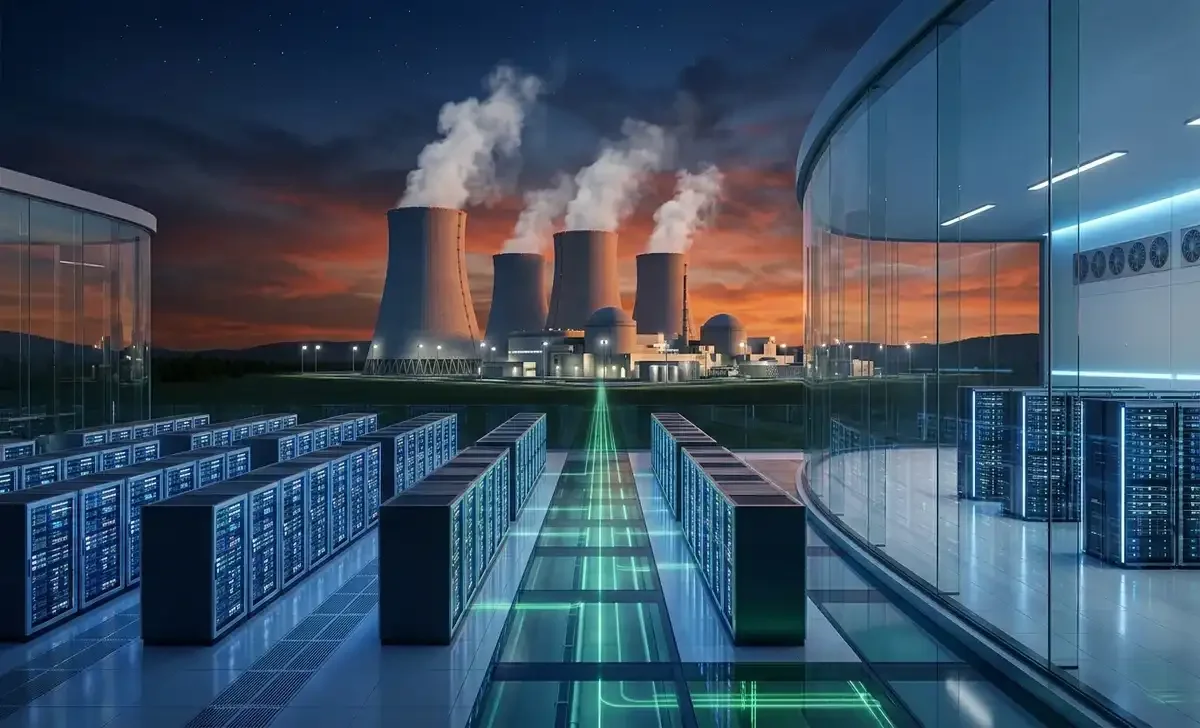
One of the most tangible expressions of the nuclear-AI convergence is the co-location trend: constructing data centers directly adjacent to — or even on the grounds of — nuclear power plants.
This approach eliminates costly long-distance transmission infrastructure, reduces power losses, and in some configurations allows a data center to connect directly to a plant's switchyard for first-priority electricity access. Constellation Energy has actively marketed available land around its nuclear plant campuses to hyperscalers.
The economics are compelling: avoided transmission costs can run into millions of dollars annually, and direct grid connections reduce exposure to regional blackouts and congestion. There is also a reputational dimension — "nuclear-powered AI" carries clean energy credibility at a time when scrutiny of tech companies' environmental impact is intensifying.
Grid Stability: The Benefit That Goes Beyond Big Tech
There is a broader argument that often gets overlooked: the nuclear-AI pairing benefits the entire electrical grid, not just the companies involved.
AI data centers add large, highly predictable loads to the grid. Nuclear plants produce large, highly predictable baseload power. From a grid-stability standpoint, that is an almost ideal pairing. Without nuclear in the mix, as AI demand grows and legacy coal and gas plants retire, the margin for error shrinks — raising the risk of brownouts and outages that affect both AI systems and ordinary consumers.
Nuclear plants also provide a service called inertia — a physical property of spinning turbines that helps stabilize grid frequency. Renewable sources do not provide this naturally. As grids incorporate more solar and wind, nuclear's inertia contribution becomes increasingly important to grid operators managing the balance between supply and demand in real time.
Regulatory Hurdles and Shifting Public Perception
The nuclear-AI story is not without friction. In the US, the Nuclear Regulatory Commission has historically moved slowly — relicensing and new approvals can take a decade or more. Both the Biden and Trump administrations signaled interest in accelerating nuclear permitting, but structural reform moves at a different pace than private-sector ambition.
Public perception remains a factor, too. Despite nuclear power's strong safety record — it is statistically one of the safest energy sources per unit of electricity generated — the legacy of Chornobyl, Fukushima, and Three Mile Island casts a long shadow. That said, sentiment is shifting, particularly among younger and climate-aware audiences who increasingly view nuclear as a necessary bridge to a clean energy future.
High-profile endorsements from Microsoft, Google, and Amazon are helping normalize the conversation. And sometimes the most consequential innovation happens far from a product launch — in rural Pennsylvania or eastern Washington State, where energy policy decisions will shape the AI industry for decades.
Key Mistakes Analysts Make When Evaluating This Trend
- Assuming nuclear means new construction only. The biggest near-term plays are restarts of shuttered plants and license extensions for operating ones — not greenfield builds.
- Overestimating SMR timelines. First commercial SMR units are unlikely before 2030–2032 in the US. Announced deals are not operating reactors.
- Ignoring transmission constraints. Getting nuclear electricity to a data center still requires grid upgrades that can take years and cost billions.
- Conflating SMRs with fusion. SMRs are deployable this decade. Commercial fusion remains 15–20 years away at minimum.
- Overlooking workforce gaps. Training reactor operators and nuclear engineers takes years. The talent pipeline is not keeping pace with announced ambitions.
FAQs
Why are AI companies investing in nuclear energy instead of expanding solar and wind?
Solar and wind are intermittent — they only generate electricity when conditions allow. AI data centers require 24/7 uninterrupted power with zero tolerance for gaps. Nuclear provides consistent, high-volume baseload electricity regardless of weather or time of day, making it far better suited to AI workloads than renewables alone.
What is a Power Purchase Agreement (PPA) in the context of nuclear energy?
A PPA is a long-term contract between an energy buyer — such as Microsoft or Google — and an energy producer, committing the buyer to purchase a set volume of electricity at an agreed price over many years. PPAs give tech companies price certainty and give nuclear operators the financial confidence to invest in new or restarted capacity.
When will Small Modular Reactors actually be powering AI data centers?
The first commercial SMR projects in the US are expected to come online between 2030 and 2035. Agreements being signed today are forward contracts — the reactors being discussed are still in development, licensing, or early construction phases.
Is nuclear power genuinely clean enough for tech companies' sustainability commitments?
Yes. Nuclear power produces near-zero greenhouse gas emissions during operation, and lifecycle emissions are comparable to wind and solar. It is fully compatible with net-zero and carbon-free energy pledges, which is why companies with aggressive sustainability targets are actively pursuing it.
What is the difference between SMR power and fusion power?
SMRs are a proven nuclear fission technology in the final stages of commercialization — expected to deliver grid power within this decade. Fusion, which mimics the energy process of the sun, remains in the experimental phase and is unlikely to be commercially available before the 2040s despite recent scientific progress.
How does nuclear energy improve overall grid stability — not just for AI?
Nuclear plants produce large amounts of constant, predictable baseload power and provide physical grid inertia through their spinning turbines, which helps stabilize grid frequency. As grids incorporate more variable renewables and retire fossil fuel plants, nuclear's stabilizing role becomes increasingly important for all electricity consumers — not just data centers.