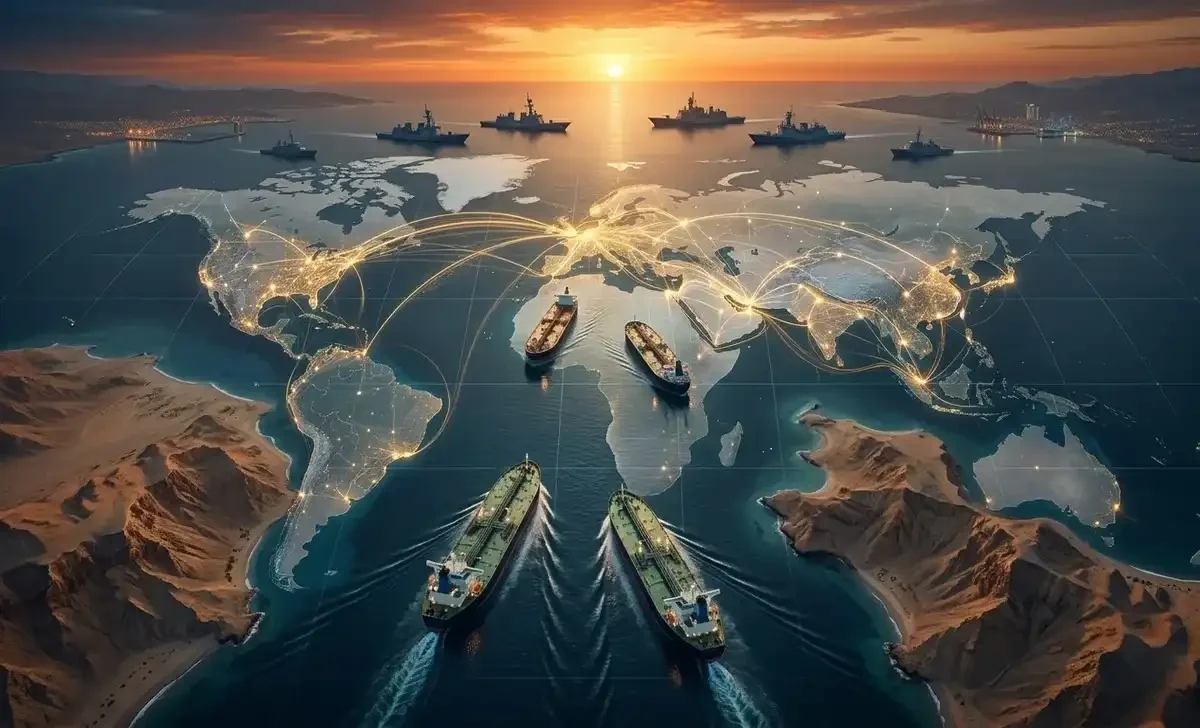
Imagine a single doorway so narrow that blocking it could trigger an economic shockwave felt in every country on Earth. That's the Strait of Hormuz.
This sliver of ocean — barely 33 kilometers wide at its narrowest point — sits between Iran and Oman at the mouth of the Persian Gulf. Every day, oil tankers carrying roughly 20% of the world's petroleum supply sail through it. When tensions flare in the region, fuel prices spike on every continent. When warships patrol its waters, investors get nervous worldwide.
In this guide, you'll get a clear, well-researched look at the strait's geography, history, geopolitical weight, and what its future may look like — with practical context you won't find in most news coverage.
What Is the Strait of Hormuz?
The Strait of Hormuz is a narrow sea channel connecting the Persian Gulf to the Gulf of Oman, which opens into the Arabian Sea. It is classified as a chokepoint — a strategic bottleneck where maritime traffic is forced through a tight corridor.
The International Energy Agency has repeatedly flagged it as the world's most important oil transit chokepoint.
What makes it uniquely critical isn't just its geography — it's what surrounds it. To the north lies Iran. To the south are the United Arab Emirates and Oman. Every major Persian Gulf oil exporter — Saudi Arabia, Iraq, Kuwait, Qatar, Bahrain, and the UAE — funnels exports through this single channel.
The bottom line: If the Strait of Hormuz closes, a massive chunk of the world's energy supply gets stuck with no adequate bypass.
Where Exactly Is It Located?
The strait sits at the southeastern corner of the Persian Gulf.
| Feature | Detail |
|---|---|
| Coordinates | ~26°N latitude, 56°E longitude |
| Narrowest width | ~33 km (21 miles) |
| Shipping lanes | Two lanes, each 3.2 km wide, with a 3.2 km buffer zone |
| Depth | 60–100 meters (deep enough for supertankers) |
The shipping lanes run close to the Omani coastline on the southern side. This setup means even a modest naval force positioned near the Iranian coastline could meaningfully threaten traffic, which is precisely why military planners around the world lose sleep over it.
How Much Oil Actually Passes Through?
According to the U.S. Energy Information Administration (EIA), approximately 17–21 million barrels of oil pass through every single day, around 20–21% of total global petroleum liquids consumption.
Beyond crude oil, the strait is a critical conduit for liquefied natural gas (LNG). Qatar, one of the world's top LNG exporters, ships virtually all of its LNG through this route.
Who receives it:
- 76–77% goes to Asian markets — Japan, China, India, South Korea
- European and American markets are impacted indirectly through global pricing mechanisms
What a disruption would cost: A prolonged closure could cause oil prices to spike by $10–$50 per barrel almost immediately.
The dependency runs deeper than crude oil headlines suggest. City-states like Singapore — which generates nearly all of its electricity from natural gas and where air conditioning alone accounts for around 40% of total national electricity consumption — are acutely exposed to any disruption in LNG flows through the strait. For countries like these, the security of this waterway isn't an abstraction; it determines whether the lights stay on.
No other single chokepoint in the world handles this volume of energy traffic.
Who Controls the Strait of Hormuz?
No single country fully controls the strait — but Iran holds the most geographic leverage.
Technically, the waterway falls under the jurisdiction of both Iran (to the north) and Oman (to the south). Under international maritime law — specifically the United Nations Convention on the Law of the Sea (UNCLOS) — it qualifies as an international strait, giving all nations the right of transit passage.
Iran has repeatedly challenged this interpretation, claiming the right to regulate or restrict transit through its territorial waters — a position most international legal experts and Western governments reject.
Oman plays a quieter but equally important role. It maintains a neutral foreign policy and has served as a diplomatic backchannel between Iran and Western nations on multiple occasions.
The United States Navy's Fifth Fleet, headquartered in Bahrain, maintains a persistent presence specifically to ensure freedom of navigation — and that presence is itself a source of ongoing geopolitical friction with Tehran.
Why Iran's Influence Matters So Much
Iran is arguably the most consequential single actor affecting the Strait's security — and that creates enormous complexity.
Iran's military has the capacity to disrupt shipping through several means: naval mines, fast attack boats, anti-ship missiles, and submarines. The Islamic Revolutionary Guard Corps Navy (IRGCN) regularly conducts exercises in the region and has a history of provocative maneuvers.
Why Iran might threaten the Strait:
- Retaliation against international sanctions
- Escalation during military confrontations with the U.S. or Israel
- Leverage in nuclear negotiations
Analysts generally consider a full closure unlikely — Iran itself needs oil revenues and imports goods through the route. But partial disruptions, tanker harassment, or mining operations are treated as realistic risks in strategic planning circles.
Key Historical Flashpoints
The strait has been an active theater of conflict and tension for decades, not just a theoretical risk.
The Tanker War (1984–1988): During the Iran-Iraq War, both sides attacked oil tankers in the Persian Gulf. The U.S. intervened with Operation Earnest Will, escorting Kuwaiti tankers under American flags.
Operation Praying Mantis (1988): A direct U.S.-Iran naval battle destroying Iranian oil platforms and naval vessels. It remains one of the largest surface engagements involving the U.S. Navy since World War II.
The 2019 Tanker Incidents: A series of tanker attacks and seizures in the Gulf of Oman were attributed by the U.S. and UK to Iran, sending global oil markets into a frenzy within hours.
The 2021 Seizure of the Asphalt Princess: Armed men briefly seized a Bahamas-flagged asphalt tanker off the UAE coast, demonstrating that commercial shipping remains vulnerable even during periods of reduced diplomatic tension.
The Impact on Global Oil Prices
When tension spikes near the Strait of Hormuz, oil traders react immediately. Futures prices jump, shipping insurance premiums soar, and downstream effects hit fuel prices at the pump within days.
Real-world examples:
- When Iran threatened to close the Strait in January 2012, Brent crude rose 3–4% in a single day
- The 2019 tanker attacks caused a 3–4% spike within 24 hours
- A confirmed closure, even temporary, could push oil past $150/barrel, according to some energy analysts
Beyond traditional futures markets, prediction markets have emerged as a useful real-time gauge of geopolitical risk. Unlike polls or analyst reports, these platforms aggregate the probabilistic judgments of thousands of participants with real money at stake — making them a sharp tool for tracking how the informed public is pricing the likelihood of Strait disruptions as they unfold.
Countries most exposed to Gulf oil — Japan, South Korea, India, and China — face the most severe immediate impacts. For these nations, the strait isn't just geopolitics. It's literally the fuel that keeps their economies running.
Alternative Routes — Do They Exist?
They do, but they're limited and come with real operational constraints.
Saudi Arabia's East-West Pipeline (Petroline): Runs from the Eastern Province to Yanbu on the Red Sea. Capacity: ~5 million barrels per day (bpd) — significant, but well below normal strait volumes.
The Abu Dhabi Crude Oil Pipeline (ADCOP): Connects Abu Dhabi's oil fields to Fujairah on the Gulf of Oman, bypassing the strait entirely. Capacity: ~1.5 million bpd.
UAE's Habshan-Fujairah Pipeline: Another alternative for UAE exports, similarly limited.
Even if all alternatives ran simultaneously at full capacity, they could divert only a fraction of the 17–21 million barrels that pass through daily. There is no full substitute. The Strait of Hormuz remains irreplaceable in any realistic short-to-medium-term scenario.
Military Presence in the Region
The strait is one of the most militarized sea lanes in the world, with several major powers maintaining ongoing operations.
United States: The Fifth Fleet maintains a persistent presence in the region. Carrier groups in the Arabian Sea can project power into the strait within hours.
Iran: The IRGCN has heavily invested in asymmetric naval capabilities — fast boats, shore-based missiles, and mines — designed specifically to counter larger conventional navies at low cost.
NATO and allied navies: The UK, France, and Australia contribute to maritime security operations. The European Maritime Awareness Mission in the Strait of Hormuz (EMASoH), launched in 2020, monitors and protects European-flagged vessels.
China: An increasingly important player. China imports roughly 40% of its oil from the Gulf, giving it a strong strategic incentive to keep the strait open. Beijing has quietly deepened naval ties with Gulf states and brokered the landmark 2023 Saudi-Iran normalization agreement — a significant shift in regional diplomacy.
The Future of the Strait of Hormuz
The long-term outlook depends on several intersecting trends.
Energy transition: As the world shifts toward renewables, demand for Gulf oil will eventually decline — but most energy analysts consider this decades away from meaningfully reducing the strait's strategic importance. One factor that could accelerate that timeline is China's massive battery overcapacity problem: with Chinese manufacturers producing far more lithium-ion battery capacity than demand can absorb, collapsing battery prices are making electric vehicles and grid storage cheaper worldwide — potentially pulling forward the global shift away from oil by years.
Iran nuclear deal status: A comprehensive nuclear agreement would ease tensions significantly. A breakdown in negotiations could push them higher. As of 2024–2025, the diplomatic situation remains unresolved.
Drone and missile technology: Advances in drone warfare make the Strait more vulnerable to asymmetric attack than ever before. Even non-state actors could potentially disrupt shipping using commercially available technology — a threat that didn't meaningfully exist a decade ago.
China's growing diplomatic role: Beijing's 2023 brokering of the Saudi-Iran normalization deal was a watershed moment. Greater Chinese involvement in Gulf diplomacy could reduce the risk of military confrontation — or complicate U.S.-led security frameworks.
The Strait will remain critically important for at least the next two to three decades. Managing its risks requires multilateral diplomacy, energy diversification, and careful de-escalation — none of which are easy.
Practical Tips for Tracking Strait Risk
- Follow EIA reports: The U.S. Energy Information Administration publishes regular updates on chokepoint oil volumes — one of the best free resources available.
- Watch shipping insurance markets: Lloyd's of London and other maritime insurers price geopolitical risk in real time. Spiking premiums are often the first sign of escalating tensions.
- Track Iran-U.S. diplomatic signals: The opening or closing of backchannel talks is a reliable leading indicator of whether the strait is about to get tense.
- Don't confuse the Persian Gulf with the Arabian Sea: The strait is the connection between the two. Getting this geography clear makes virtually every news story about the region easier to follow.
Common Mistakes to Avoid
Assuming a closure is imminent every time Iran makes threats. Iran has issued dozens of closure threats over the years. Analysts treat these as bargaining chips rather than operational intentions in most cases — the costs to Iran itself are simply too high.
Underestimating Oman's role. Oman's quiet, neutral diplomacy has been a genuine stabilizing force. Its territory forms the southern border of the strait, and its government has consistently worked to prevent tensions from boiling over.
Overlooking LNG. Most coverage focuses on crude oil, but LNG transit is equally critical — especially for Qatar's massive export program and for energy-hungry Asian economies where natural gas powers electricity grids.
Thinking that alternative pipelines solve the problem. Existing bypass routes cover only a fraction of normal strait volumes. There's no quick fix, and building meaningful new capacity takes years and enormous capital investment.
Conclusion
The Strait of Hormuz is more than a geographic feature — it's a pressure point where energy security, military strategy, and great-power competition converge in real time. Every cargo ship that passes through it reflects a web of diplomatic relationships, naval deterrence, and economic interdependence that spans the globe.
Understanding the Strait means understanding why oil prices jumped this week, why a naval exercise in the Persian Gulf makes headlines in Tokyo and Seoul, and why a narrow channel between Iran and Oman has commanded the attention of policymakers for more than half a century.
The stakes are high enough that no single country has been willing to let it close, and high enough that the possibility of disruption never fully leaves the table.
FAQs
Why is the Strait of Hormuz so important to global oil supply?
It's the only exit route for oil exported from the major Persian Gulf producers — Saudi Arabia, Iraq, Iran, UAE, Kuwait, and Qatar — which collectively hold a disproportionate share of global proven reserves. Approximately 20% of the world's oil passes through daily, making it the single most critical energy chokepoint on Earth.
Can Iran actually close the Strait of Hormuz?
Iran has the military capability to seriously disrupt traffic using mines, missiles, and fast-attack vessels. A full, sustained closure would be extremely difficult to maintain against U.S. and allied naval forces, and would also hurt Iran's own economy. Most analysts consider severe disruption more realistic than complete closure.
What happens to oil prices if the strait is blocked?
Prices would spike dramatically — potentially by tens of dollars per barrel within days. The magnitude depends on the duration and how quickly alternative routes can be activated. Even a brief closure sends shockwaves through global markets.
Which countries would be most affected by a closure?
Japan, South Korea, China, and India are the most directly dependent on Gulf oil and would face the most severe immediate impacts. European and North American countries would be affected through global price increases, even if they import less Gulf oil directly.
Is the Strait of Hormuz in international waters?
It qualifies as an international strait under UNCLOS, meaning all nations have the right of transit passage. Iran disputes aspects of this interpretation, arguing it can regulate passage through its territorial waters — a position rejected by most international legal experts and Western governments.
Has the Strait ever actually been closed?
No. Despite numerous threats and significant incidents, the strait has never been fully closed. The Tanker War of the 1980s came closest to sustained disruption, but traffic continued even as attacks occurred. The economic consequences of a genuine closure are considered so catastrophic that all parties — including Iran — have strong incentives to avoid it.
What is the IRGCN, and why does it matter for the Strait?
The Islamic Revolutionary Guard Corps Navy is a branch of Iran's military that operates separately from the conventional Iranian Navy. It specializes in asymmetric tactics — fast boats, mines, and shore-based missiles — designed to threaten larger naval forces at low cost. The IRGCN regularly patrols the strait and has been involved in most of Iran's provocative maritime incidents.