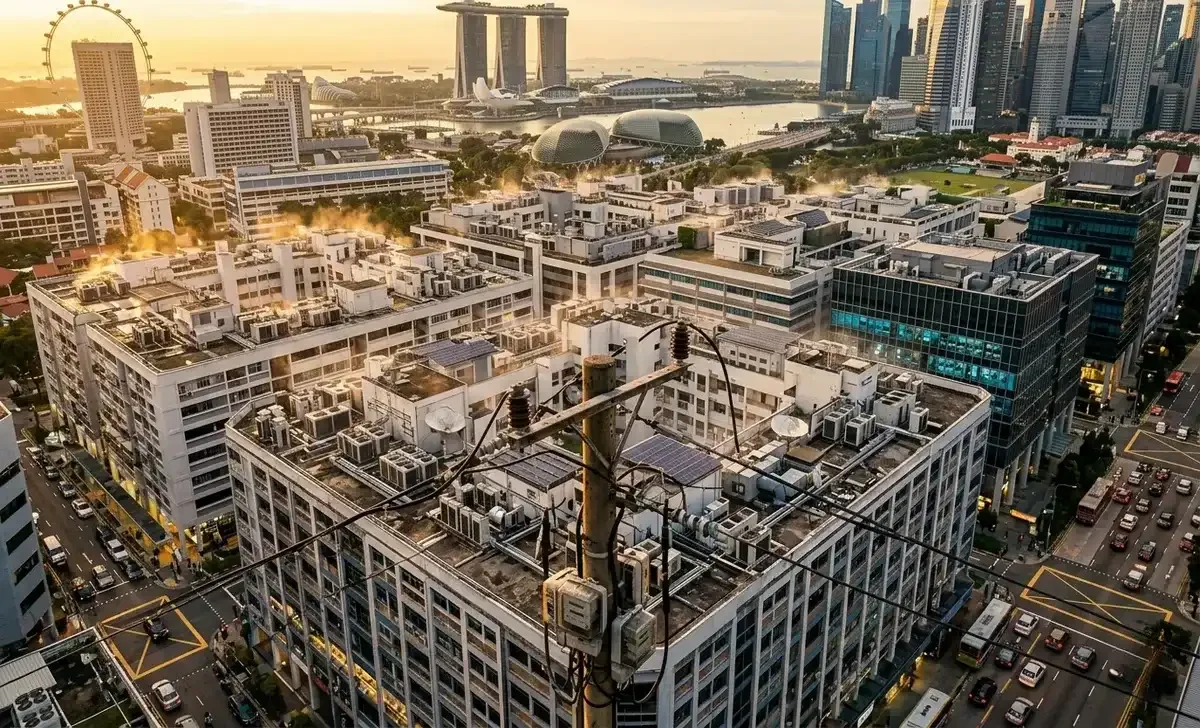
Walk into any hawker centre, MRT station, office, or HDB flat in Singapore, and you'll feel it immediately — that familiar blast of cold air. Air conditioning isn't just a luxury here. For most Singaporeans, it's a survival tool in a country where temperatures rarely dip below 25°C and humidity hovers around 80% year-round.
But Singapore's air conditioning energy crisis is becoming impossible to ignore. The island-state is one of the most air-conditioned places on earth, and that comes at a steep cost — financially, environmentally, and in terms of grid stability. With global energy prices volatile and climate targets looming, the question is no longer whether Singapore can keep cooling itself this way, but how long it can afford to.
In this article, you'll learn exactly why this crisis is unfolding, what's driving it, and — most importantly — what individuals, businesses, and policymakers can actually do about it.
1. Why Singapore Is So Dependent on Air Conditioning
Singapore's relationship with air conditioning goes back decades. When Lee Kuan Yew called air conditioning "one of the most important inventions in history," he was speaking as a leader who watched it transform Singapore from a sweltering colonial port into a productive, world-class city-state.
The climate simply doesn't allow much of an alternative. Singapore sits just one degree north of the equator. Daytime temperatures average between 31°C and 34°C, and the humidity makes it feel even hotter. Unlike temperate countries that endure a few hot weeks a year, Singapore faces this every single day.
Air conditioning enabled Singapore's economic miracle — long working hours, dense office towers, manufacturing plants, and data centres all became viable. But that foundation now creates a structural dependency that's very hard to unwind. Entire buildings, urban layouts, and even cultural norms have been built around the assumption that indoor air will always be chilled.
2. How Much Energy Does Air Conditioning Actually Use?
The numbers are staggering. Air conditioning accounts for approximately 40% of Singapore's total electricity consumption. In commercial buildings and offices, that figure rises even higher — sometimes reaching 60% of a building's total energy use.
Compare that to the global average of around 20%, and the scale of Singapore's aircon energy problem comes into sharp focus.
Residential households feel it too. The average Singapore home spends more on cooling than on any other electrical appliance. A typical split-unit air conditioner running 8 hours a day can consume 3–5 kWh per day — more than a refrigerator, washing machine, and television combined.
At the national level, this massive energy draw puts constant pressure on Singapore's power generation infrastructure and contributes significantly to its carbon emissions. And with Singapore's population growing and temperatures rising due to climate change, demand is only heading in one direction.
3. The Urban Heat Island Effect Making Things Worse
Here's a cruel irony: the more air conditioning Singapore uses, the hotter the city gets, which then drives the need for even more air conditioning.
This is the urban heat island (UHI) effect. Every air conditioning unit works by pulling heat from indoors and dumping it outside. Multiply that by millions of units across a dense city, and you're pumping enormous volumes of waste heat into the streets and atmosphere.
Studies show that Singapore's urban temperatures are already 1–4°C warmer than surrounding rural or forested areas, largely due to this effect. That difference might sound small, but it's enough to make outdoor spaces unbearable and push more people indoors — back into air-conditioned environments.
The cycle is self-reinforcing. It's one of the central challenges in solving Singapore's cooling crisis: you can't just tell people to switch off their aircon when the outdoor environment itself has been made hotter by air conditioning.
4. Singapore's Energy Grid: A System Under Pressure
Singapore generates almost all of its electricity from natural gas — around 95%. That means the country is exposed to global gas price swings, supply disruptions, and the ongoing energy market turbulence that has affected prices worldwide since 2021.
That vulnerability extends beyond economics. A significant share of the world's liquefied natural gas passes through a single, geopolitically sensitive chokepoint — and as analysis of the Strait of Hormuz makes clear, any disruption to that waterway would have immediate and severe consequences for LNG-dependent nations like Singapore. For a country that cannot simply switch fuel sources overnight, the stability of that shipping lane is as critical to daily life as the power cables running beneath its streets.
The Singapore aircon energy crisis intersects directly with this grid vulnerability. When cooling demand peaks — during hot afternoons or in the lead-up to storms — the grid faces its highest stress. Singapore's Energy Market Authority (EMA) has invested heavily in grid resilience, but the sheer volume of air conditioning load remains a core challenge.
There's also the long-term picture. Singapore has committed to net-zero emissions by 2050. Natural gas is cleaner than coal, but it still produces CO₂. Transitioning to renewable energy sources while meeting growing cooling demand is one of the most complex energy planning challenges the country faces.
Solar power is being expanded aggressively — on HDB rooftops, reservoirs, and industrial buildings — but Singapore's land constraints mean solar alone won't solve the problem. Imported low-carbon energy via undersea cables from regional neighbours is being explored, but those projects are still years away from meaningful scale.
5. The Carbon Footprint of Staying Cool
Singapore's air conditioning habit leaves a significant carbon trail. In 2023, Singapore's total carbon emissions stood at around 51 million tonnes of CO₂ equivalent. Energy use in buildings — dominated by cooling — accounts for a substantial portion of that figure.
The situation becomes even more concerning in the context of global climate change. Hotter global temperatures mean more cooling demand, which means more emissions, which means hotter temperatures. It's a feedback loop that researchers call the "cooling trap."
Singapore is acutely aware of this. Its Green Plan 2030 sets ambitious targets for reducing energy intensity in buildings, increasing solar capacity, and promoting energy-efficient cooling. The country also imposes a carbon tax — currently S$25 per tonne and rising to S$50–80 per tonne by 2030 — which is beginning to change the economics of energy-intensive businesses.
6. Rising Electricity Tariffs: What It Means for Households
Singaporeans have felt the crunch directly in their electricity bills. Tariffs rose sharply from 2022 onward, driven by global gas price volatility. While prices have partially stabilised, they remain higher than pre-2021 levels and are subject to quarterly adjustments.
For a typical 4-room HDB flat, monthly electricity bills can range from S$80 to S$180, depending on aircon usage. Families running air conditioning through the night — which is common given the heat — often find cooling to be their single biggest household expense after rent.
Singapore is far from alone in this bind. California residents are grappling with a remarkably similar set of pressures — electricity costs driven up by infrastructure spending, rising demand from extreme heat events, and the financial burden falling hardest on lower-income households. The parallels are a reminder that unaffordable energy is fast becoming a global urban challenge, not just a local inconvenience.
The economic pressure is hitting lower-income households hardest. For families who can't afford newer, energy-efficient models, older air conditioning units consume far more electricity for the same cooling output. It's a classic energy-poverty trap: those who can least afford high bills often own the least efficient equipment.
7. What the Government Is Doing About It
Singapore's government has moved on multiple fronts to address the air conditioning energy crisis:
Mandatory Energy Labelling: All aircon units sold in Singapore must carry an NEA Energy Label (1 to 5 ticks). Units with more ticks are significantly more efficient. From 2022, only 3-tick-and-above models can be sold.
BCA Green Mark Scheme: Buildings must meet minimum energy performance standards, with incentives for going further.
District Cooling Systems: In new developments like Marina Bay and Tengah, centralised district cooling plants supply chilled water to multiple buildings — far more efficiently than individual units.
Research Investment: The S$25 million National Cooling Programme funds research into tropical building design, passive cooling, and next-generation air conditioning technology.
Climate-Friendly HDB Design: Newer HDB blocks are oriented to maximise natural ventilation and shade, reducing baseline cooling demand from the start.
8. Green Cooling Technology: The Innovations Changing the Game
The good news is that technology is advancing fast. A new generation of cooling solutions is beginning to challenge the dominance of conventional air conditioning:
Variable Refrigerant Flow (VRF) Systems adjust output precisely to match cooling demand, wasting far less energy than traditional fixed-speed compressors.
Inverter aircon technology — already common in newer Singapore models — achieves similar efficiency gains at the residential level, using up to 30–50% less electricity than older units.
Radiant cooling systems cool surfaces rather than air, which is more energy-efficient and results in a more comfortable environment.
AI-powered building management systems can learn occupancy patterns and pre-cool spaces before people arrive, avoiding peak-demand charges and unnecessary runtime.
Phase-change materials embedded in building walls absorb heat during the day and release it at night, reducing the indoor temperature rise that triggers air conditioning use.
None of these will replace conventional cooling overnight. But together, they represent a credible pathway toward a less energy-intensive cooling future.
9. How Buildings and Offices Can Lead the Change
Commercial buildings are where the biggest efficiency gains are available — and where change can happen fastest with the right incentives.
Smart building controls that integrate occupancy sensing, weather data, and historical usage patterns can cut commercial cooling energy by 20–30% with no reduction in comfort.
Green leasing clauses are emerging in Singapore's commercial property market, where landlords and tenants share the benefits of energy efficiency investments — removing the traditional split-incentive problem.
Façade improvements — better glazing, external shading, and reflective coatings — reduce the heat entering a building before the air conditioning even needs to respond.
Ventilation-first design, common in passive house architecture, uses fresh air strategically to delay the point at which mechanical cooling becomes necessary.
The regional real estate landscape is also shifting in ways that will influence Singapore's built environment. Sunway Group — one of Malaysia's largest conglomerates — recently expanded into Singapore through its acquisition of local developer MCL Land, a move that signals growing regional appetite for Singapore's property market. As more developers of this scale enter the market, meeting Singapore's increasingly stringent green building standards will become a baseline expectation rather than a differentiator.
Several Singapore developers, including CapitaLand and City Developments Limited, have made public commitments to achieve net-zero carbon operations in their portfolios by 2030. Their buildings are becoming test beds for the green cooling approaches that will eventually become standard across the industry.
10. What You Can Do Today to Cut Your Aircon Bill
You don't need to renovate your flat or buy an entirely new system to make a meaningful difference. Small, practical changes add up quickly:
Set your thermostat to 25°C. The NEA recommends this as the sweet spot — comfortable for most people and significantly more efficient than the 19°C many units default to.
Use a timer or smart plug. Running the air conditioner for 30 minutes before bed and switching to a fan overnight saves hours of runtime.
Service your aircon every 3 months. A dirty filter can reduce efficiency by 10–15%, costing you money without improving cooling.
Use curtains and blinds during the day. Blocking sunlight reduces the heat load your air conditioner needs to handle.
Upgrade to a 5-tick unit. If your aircon is more than 10 years old, a new 5-tick inverter model will typically pay for itself in energy savings within 2–3 years.
Seal gaps around doors and windows. Cool air leaking out means your unit works harder and longer.
Try ceiling fans alongside air conditioning. Moving air feels cooler, allowing you to raise the thermostat set point by 2–3°C without discomfort.
Expert Tips
Dr Ernest Chua, a leading researcher in tropical building science at NUS, has consistently advocated for what he calls "climate-responsive design" — buildings that work with Singapore's climate rather than against it. His key insight: passive cooling should always be the first line of defence, not air conditioning.
Additional expert-backed recommendations:
Avoid overnight air conditioning if possible. A quality ceiling fan with a dehumidifier is often sufficient for sleeping comfort in Singapore's climate.
Monitor your usage with a smart meter. Awareness alone tends to reduce consumption by 10–15%, according to energy behaviour research.
Consider a multi-split system over multiple single-split units. One outdoor compressor serving multiple rooms is meaningfully more efficient than separate systems per room.
Check the Seasonal Energy Efficiency Ratio (SEER), not just the star rating. A higher SEER means better real-world performance.
Common Mistakes to Avoid
❌ Setting the temperature too low. Every degree below 25°C increases energy consumption by roughly 10%. Many people set 18°C and then add a blanket, which makes no sense energetically.
❌ Leaving the air conditioner on in empty rooms. Motion-sensing smart controls can eliminate this.
❌ Skipping annual servicing. This is the single most common cause of poor performance and high bills.
❌ Buying the cheapest unit without checking the tick rating. A cheap 1-tick aircon will cost you far more over its lifetime than a quality 5-tick model.
❌ Ignoring the outdoor compressor unit's placement. A compressor sitting in direct sunlight or in a poorly ventilated space has to work significantly harder. Shade and airflow around the outdoor unit meaningfully improve efficiency.
❌ Cooling an uninsulated space. If your ceiling has no insulation and the sun beats down on it all day, your air conditioner is fighting a losing battle. Roof insulation is one of the highest-ROI home improvements in Singapore.
FAQs
How much of Singapore's electricity is used by air conditioning?
Air conditioning accounts for approximately 40% of Singapore's total electricity consumption — one of the highest proportions of any country in the world. In commercial buildings, that share can rise to 60%.
What is the most energy-efficient air conditioning temperature setting in Singapore?
The NEA recommends setting your air conditioner to 25°C. This balances comfort with energy efficiency. Each degree lower than this increases energy consumption by around 10%, so small adjustments to your thermostat setting make a measurable difference to your electricity bill.
Why is Singapore's electricity bill so high compared to its neighbours?
Singapore's electricity costs more partly because it imports almost all of its energy in the form of natural gas, which exposes it to global commodity price swings. High air conditioning demand — both residential and commercial — also drives up grid load and associated costs.
What is Singapore doing to reduce its air conditioning energy consumption?
Singapore is tackling this through mandatory energy efficiency labelling for aircon units, the BCA Green Mark scheme for buildings, district cooling infrastructure in new developments, the National Cooling Programme research fund, and carbon taxes that make energy-intensive operations more expensive.
Is there a realistic alternative to air conditioning in Singapore's climate?
For most people, fully replacing air conditioning isn't realistic given Singapore's heat and humidity. However, a combination of good building design, ceiling fans, dehumidifiers, and targeted air conditioning use (rather than running it 24/7) can significantly reduce dependence. New research into passive cooling and climate-responsive architecture is also opening up more options for the future.