If you've priced an EV recently, watched battery stocks, or followed US-China trade headlines, you've run into the same phrase over and over: China battery overcapacity. It's one of the most consequential — and least explained — stories in the global energy transition.
In short: China can now build far more lithium-ion batteries than the world can currently buy. That imbalance is reshaping battery prices, EV affordability, Western manufacturing strategy, and trade policy all at once. This guide breaks down what's actually happening, who it affects, and how it's likely to play out over the next few years.
What "Battery Overcapacity" Actually Means
Overcapacity is simple in concept: it's the gap between how many batteries factories can produce and how many the market actually needs.
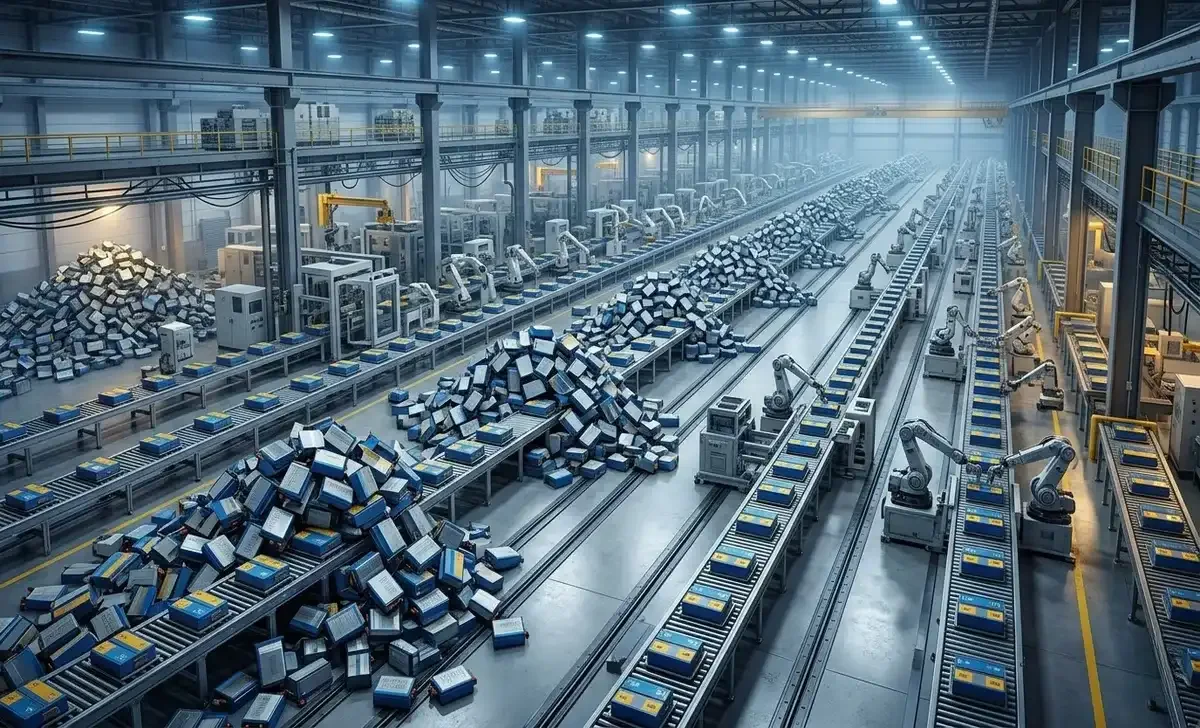
China controls an estimated 75–80% of global lithium-ion battery manufacturing capacity — cells for EVs, grid storage, and consumer electronics combined. Over the past decade, Chinese provinces and private investors built out that capacity aggressively, betting that EV demand would keep growing at pandemic-era rates. Demand growth cooled; capacity kept expanding anyway.
The result: many Chinese battery factories run well under full utilization, cell prices have fallen sharply, and Beijing itself has stepped in to discourage further expansion — an unusual move for an industry the government spent over a decade promoting.
This isn't the first time China has hit this pattern. Solar panels and steel went through nearly identical boom-bust-consolidation cycles in the past 15 years. Batteries are simply the newest — and strategically most important — sector to follow the same script.
How Big Is the Gap?
Precise figures vary by analyst and change quickly, but the broad shape of the problem is consistent across industry reporting:
- China's installed battery manufacturing capacity has expanded far faster than global demand for EVs and grid storage.
- Utilization rates at many mid-sized and smaller Chinese battery makers have fallen well below the 80%+ level typically needed to be reliably profitable at scale; some plants have idled entire production lines, reportedly.
- CATL, the world's largest battery maker, has held up better than most because of its scale and export volume, but even it has faced margin pressure.
- Dozens of smaller and mid-tier battery manufacturers have shut down, restructured, or been acquired since 2023.
The exact tonnage or GWh figures are less important than the trend: Chinese battery capacity has been growing faster than the market that's supposed to absorb it, for several consecutive years.
Why This Happened: Four Root Causes
1. A decade of aggressive state and local subsidies. Provincial governments competed to host battery factories, offering cheap land, tax holidays, and subsidized loans. That made building new capacity cheap relative to the risk — even when demand signals were uncertain.
2. Overconfident extrapolation of the 2020–2022 EV boom. Chinese EV sales grew extremely fast for a few years. Battery makers scaled up as if that growth rate were permanent. It wasn't — EV adoption is now following a more typical S-curve, with slower growth as the market matures.
3. A uniquely fragmented industry. South Korea consolidated its battery industry around a handful of large players (LG Energy Solution, Samsung SDI, SK On). China instead developed hundreds of battery manufacturers, many building similar capacity at the same time — a classic collective-action failure where each company's rational individual bet became irrational in aggregate.
4. Export-driven overbuilding. Some capacity was never sized only for the domestic market; it assumed continued open access to Europe, Southeast Asia, and the US. Tariffs and local-content rules have since narrowed that assumption.
Who's Actually Exposed — With Examples
Not every Chinese battery company faces the same risk.
- CATL (~37% global market share) has scale, export volume, and diversified customers. It can sustain a price war longer than rivals and is investing in next-generation chemistries like sodium-ion and solid-state to move up the value chain rather than compete purely on price.
- BYD is vertically integrated — it builds batteries mainly for its own EVs, which insulates it somewhat from spot-price battery competition, though it too has expanded capacity aggressively.
- Mid-tier producers — companies like CALB, Gotion High-Tech, and Farasis Energy — are the most exposed. They compete for shrinking margins, often lose contracts to CATL or BYD on price or reliability grounds, and several have seen share prices fall well below their IPO valuations since listing between 2020 and 2022.
- Outside China, Sweden's Northvolt is the most cited cautionary example: once positioned as Europe's flagship battery champion, it went through a severe financial restructuring in 2024, a collapse driven partly by production and quality problems, but sharpened by its inability to match Chinese price points.
Practical example: an automaker sourcing LFP cells in 2022 vs. 2025 has seen per-kWh cell costs fall dramatically — a direct pass-through of Chinese overcapacity into global supply contracts. That's good news for buyers today, but it's exactly the dynamic making it hard for non-Chinese factories to reach profitability before Chinese competitors can undercut them again.
How Beijing Is Responding
China's government has shifted from encouragement to active restraint — a notable reversal after years of promoting battery manufacturing as a strategic priority. Recent regulatory guidance has pushed manufacturers to:
- Avoid speculative, "irrational" capacity expansion
- Compete on quality and chemistry innovation rather than price alone
- Consolidate through mergers where possible
- Redirect investment toward higher-value segments like solid-state and next-generation cells
The goal is an engineered shakeout: let weaker producers fail or merge while protecting national champions like CATL and BYD. Regulators are also expected to tighten access to subsidized financing for new capacity and to encourage state-brokered mergers, similar to the pattern that eventually stabilized China's solar industry after its own overcapacity crisis in the early 2010s.
The Global Price War — and Why It Matters Beyond China
Idle factories don't sit quietly; they cut prices and chase export orders. That's exactly what's happened: LFP cell prices have fallen to levels that would have seemed implausible three years ago.
For buyers — automakers, grid storage developers, electronics makers — cheaper cells are an unambiguous short-term win. For battery manufacturers outside China, it's closer to an existential threat, because European and American plants carry higher labor and compliance costs and don't have the same scale or subsidized capital base.
This dynamic is the direct policy justification behind the US Inflation Reduction Act's domestic-content requirements and the EU's battery regulation framework: without some form of tariff or subsidy shield, policymakers argue, Chinese overcapacity could crowd out Western battery manufacturing before it has a chance to reach competitive scale. It's also central to broader disputes over trade imbalances and industrial policy, discussed in more depth in this explainer on the US trade gap.
What It Means If You're Buying an EV
If you're shopping for an EV, overcapacity is currently working in your favor. Battery cells typically make up 30–40% of an EV's total cost, so falling cell prices flow fairly directly into vehicle pricing.
- In markets where Chinese EVs are sold directly — parts of Europe, Southeast Asia, Australia, Latin America — brands like BYD, SAIC, and Geely are pricing well below equivalent Western models.
- In the US, tariffs largely block direct import of Chinese EVs, but the downward price pressure still filters through, pushing legacy automakers to price their own EVs more aggressively to stay competitive.
The trade-off: today's low prices are partly a symptom of an unstable industry structure. If a wave of consolidation removes weaker suppliers, some of that pricing pressure could ease over the next few years.
Beyond EVs: Grid Storage Has Its Own Overcapacity Story
Most coverage of this topic focuses on EV batteries, but grid-scale energy storage is arguably just as important and growing faster in percentage terms. Utilities are relying increasingly on battery storage to manage demand spikes, renewable intermittency, and — in some regions — the strain that extreme heat and cooling demand put on the grid.
That strain shows up directly in consumer costs; regional utility pricing debates, like those covered in this look at rising California utility bills, are increasingly tied to how much grid-scale storage capacity a region can bring online affordably — capacity that is itself being shaped by the same cheap-Chinese-cell dynamic driving EV prices down.
The Geopolitical Dimension
Battery overcapacity has become a genuine trade flashpoint, not just a market story. The US, EU, Canada, and other governments have imposed or are considering tariffs on Chinese EVs and batteries, arguing that state-subsidized capacity allows pricing below fair market value. China disputes this, framing its competitiveness as the product of scale, R&D investment, and manufacturing experience rather than distortive subsidies.
This dispute plays out in the WTO, in bilateral negotiations, and increasingly on the ground: Chinese battery firms are building plants in Southeast Asia, Latin America, and the Middle East, partly to sidestep tariffs while securing new markets and supply routes. Battery and EV supply chains have effectively become one front in the broader competition over strategic energy and technology infrastructure — a competition that echoes older energy-security debates, such as those tied to critical transit points like the Strait of Hormuz, where a handful of geographic or industrial chokepoints determine outsized global leverage.
What Happens Next: Three Scenarios
Scenario A — Orderly consolidation. Beijing successfully manages the shakeout. Weak producers exit or merge, utilization improves, CATL and BYD emerge stronger, and prices stabilize at a new, lower-but-sustainable equilibrium.
Scenario B — Prolonged price war. Consolidation drags on. Export-driven overproduction continues, global prices stay depressed, Western gigafactories struggle to reach profitability, and trade barriers escalate in response.
Scenario C — Technology disruption. Solid-state or other next-generation chemistries mature faster than expected, reshuffling competitive advantage and partially resetting the overcapacity problem in conventional lithium-ion around a new technology curve.
Most industry analysts expect a blend of A and B: a messy, uneven consolidation accompanied by continued trade friction, rather than a clean resolution in either direction.
Practical Takeaways
- If you're buying an EV now: battery costs are near historic lows relative to energy density — a reasonable time to buy, though prices may firm up somewhat as consolidation progresses.
- If you're an automaker or OEM buyer: locking in supply agreements now captures low prices, but over-reliance on a shrinking pool of Chinese suppliers carries geopolitical and continuity risk — diversify sourcing where possible.
- If you're evaluating battery-sector investments: mid-tier Chinese manufacturers carry meaningful survival risk. Scale leaders (CATL, BYD) and companies with genuine IP in next-generation chemistries are better positioned than commodity LFP producers.
- If you're a policymaker: tariffs buy time for the domestic industry but don't build competitiveness on their own — pair trade protection with sustained investment in skills, supply chains, and R&D.
Common Misconceptions
- "Overcapacity means Chinese batteries are low quality." Not true — CATL and BYD cells are widely regarded as best-in-class. This is a capital-allocation and industry-structure problem, not a quality one.
- "Tariffs alone will fix Western competitiveness." Tariffs create breathing room, but without investment in workforce skills and supply chains, that room goes unused.
- "China's battery sector is a monolith." The gap between CATL/BYD and struggling mid-tier producers is enormous — generalizing about "Chinese batteries" obscures where the real financial stress sits.
- "This is only an EV story." Grid-scale storage overcapacity is a parallel, fast-growing dynamic with its own supply and pricing effects.
Conclusion
China's battery overcapacity isn't a temporary glitch — it's the predictable result of a decade of aggressive, fragmented industrial expansion meeting a maturing EV market. The near-term effect is cheaper batteries and cheaper EVs worldwide, which is genuinely good news for buyers. The longer-term effect is a harder, more consolidated industry, sharper trade tensions, and real uncertainty for battery manufacturers trying to build outside China's cost structure. Whether that resolves through orderly consolidation, a prolonged price war, or a technology leap to next-generation chemistries will shape EV and energy storage prices for the rest of the decade — making this one of the more important industrial stories to keep watching, well beyond the battery sector itself.
FAQs
What does "battery overcapacity" mean in simple terms?
It means battery factories, mostly in China, can produce far more cells than current global demand requires — leading to falling prices, low factory utilization, and financial strain across the industry.
Is China's battery overcapacity good or bad for consumers?
In the short term, it's good — it's a major reason EV and battery prices have fallen. Longer term, if it eliminates competition outside China, it could create supply chain concentration risk.
Why is the Chinese government telling battery makers to slow down?
Regulators are trying to avoid a repeat of the solar industry's 2011–2013 overcapacity crash — wasted capital, factory failures, and international trade backlash that ultimately damages China's own strategic interests.
How does this affect US EV and trade policy?
It's one of the central justifications for US tariffs on Chinese EVs and batteries, and for domestic-content requirements in the Inflation Reduction Act — designed to give US manufacturers room to scale without being undercut by lower-cost, subsidized imports.
Will the overcapacity problem resolve on its own?
Partially. Market forces will push some consolidation as weaker producers exit. But given how much state involvement shaped the buildup, the shakeout is likely to be slower and more managed than a purely market-driven correction.
Which companies are safest from the shakeout?
CATL and BYD, due to scale, export reach, and (for BYD) vertical integration into EV manufacturing. Mid-tier and smaller producers carry the most risk.