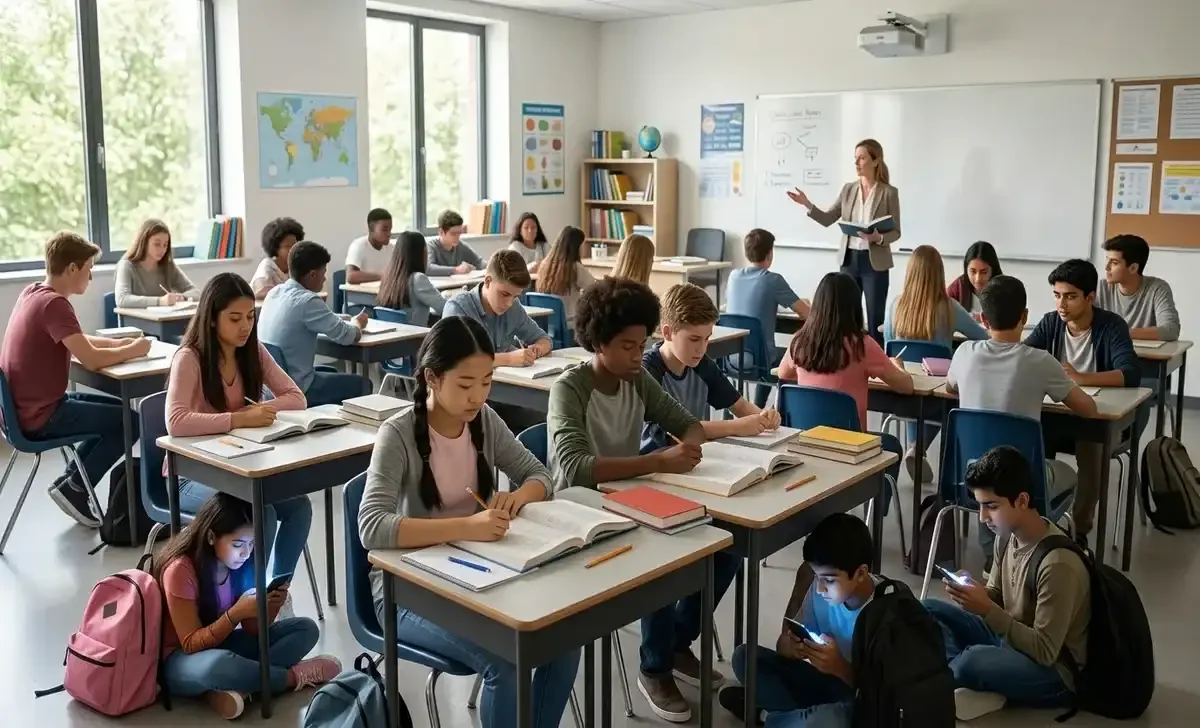
Walk into almost any school hallway today and you'll see the same thing — students staring at screens. Smartphones in schools have gone from a novelty to a full-blown controversy. Some teachers swear phones are ruining education. Some students argue they can't function without them. And parents? They're stuck somewhere in the middle.
The truth is more complicated than either side admits.
This article breaks down exactly what's happening with smartphones in schools — what the research actually says, what's working, what's failing, and what you can do about it whether you're a parent, educator, or student. No fluff. Just real, useful information.
1. Why Smartphones in Schools Are Such a Big Deal
This isn't just about kids texting during math class. The debate around smartphones in schools touches on bigger questions — how we learn, how we connect, and what kind of adults we're raising.
In 2024, the issue reached a tipping point. UNESCO called for a global ban on phones in schools. Multiple governments acted. Teachers unions issued statements. Opinion pieces flooded the internet. And yet — many schools still have no clear policy at all.
Here's why this matters so much right now:
- Students spend an average of 4–7 hours per day on their phones, including during school.
- Notification culture has fundamentally changed how brains process attention.
- The generation currently in school has never known life without smartphones.
The stakes are high. Get this wrong and we risk damaging a generation's education. Get it right, and technology could be one of the most powerful learning tools ever created. The difference lies in how we approach it.
2. The Real Impact on Student Learning
Let's start with what we know for certain: smartphones affect learning. The question is how much and in what direction.
Research from the London School of Economics found that after schools banned phones, test scores among underperforming students improved by 14.23%. That's not a small number. That's the difference between passing and failing for many kids. If you're looking beyond phone policy for broader ways to close the achievement gap, these proven strategies for improving student achievement offer a useful wider framework.
Why does it happen? It comes down to something called cognitive bandwidth. When a student's brain is partially focused on a notification — even one they haven't opened — their ability to absorb new information drops significantly. This is sometimes called the "brain drain" effect, and it's been replicated in multiple studies.
But here's the nuance: the type of phone use matters enormously.
- Passive use (scrolling, watching videos): Consistently linked to lower academic performance.
- Active use (research, educational apps, note-taking): Can genuinely support learning when structured properly.
The problem is that most schools don't distinguish between the two. Blanket rules end up punishing productive use along with the harmful kind.
3. Mental Health: The Hidden Crisis in Your Child's Pocket
This is perhaps the most urgent part of the conversation. Smartphones in schools aren't just an academic issue — they're a mental health issue.
Since 2012, rates of anxiety, depression, and loneliness among teenagers have risen sharply. That's also roughly when smartphone ownership became near-universal among teens. Researcher Jonathan Haidt, author of The Anxious Generation, argues this is not a coincidence.
During school hours specifically, the impact is direct:
- Cyberbullying can happen in real-time, during class, with no teacher awareness.
- Social comparison on platforms like Instagram and TikTok peaks during the school day when students are most exposed to each other.
- Fear of missing out (FOMO) keeps students mentally outside the classroom even when physically present.
Girls appear to be disproportionately affected. Studies show higher rates of social anxiety tied to phone use during school among female students — though boys are far from immune.
The school environment, once a social pressure cooker on its own, has now become a 24/7 social performance stage. That's a lot for a developing brain to handle.
4. Social Media in the Classroom — A Double-Edged Sword
Nobody planned for TikTok to become part of the school day. But here we are.
Social media apps are deliberately engineered to capture and hold attention. Their algorithms are more sophisticated than most classroom lessons. Students aren't choosing distraction over education — they're being pulled by systems specifically designed to be irresistible.
The negatives are well-documented:
- Shortened attention spans
- Disrupted lesson flow
- Peer pressure to stay constantly connected
- Exposure to inappropriate content during school hours
But there are legitimate use cases too:
- Students use YouTube to revisit difficult concepts
- Teachers use social platforms to make content relatable
- Student journalism and media programs rely on these tools
The challenge for schools isn't to pretend social media doesn't exist. It's to teach young people to use it with intention — which requires adults who understand it themselves.
5. When Smartphones Actually Help Learning
Here's something anti-phone advocates don't always acknowledge: used thoughtfully, smartphones can be remarkable educational tools.
Consider these real classroom applications:
- Google Classroom & similar platforms allow teachers to share resources, assignments, and feedback instantly.
- Language learning apps like Duolingo have shown genuine results for vocabulary acquisition.
- Khan Academy and YouTube give students access to expert explanations on demand.
- Calculator and research tools speed up the problem-solving process when properly supervised.
- Accessibility features — text-to-speech, screen magnifiers, translation tools — are lifelines for students with learning differences.
In rural or under-resourced schools, a student's smartphone may be their only access to the internet and educational resources outside school. A blanket ban in these environments could actually increase inequality, not reduce it. This is part of why sustained investment in education — in infrastructure, devices, and teacher support — matters as much as any individual policy decision.
The key word in all of this is structure. Smartphones help when the teacher controls the what, when, and how of their use. Without that structure, they almost always become a distraction.
6. Phone Bans: Do They Actually Work?
Phone bans are popular. They're politically easy to announce and parents generally support them. But do they work in practice?
The answer: sometimes, and it depends on how they're implemented.
Effective approaches include:
- Phone pouches (like Yondr pouches) that physically lock devices
- Designated storage boxes at classroom doors
- Clear, consistent enforcement school-wide
Less effective approaches include:
- "Phones in bags" policies with no enforcement
- Teacher-by-teacher inconsistency
- No explanation given to students about why the rule exists
France introduced a nationwide school phone ban in 2018. A 2023 review showed mixed results — the ban worked better in primary schools than secondary schools, where enforcement is harder and student autonomy expectations are higher.
Australia, the UK, and several US states have followed with similar policies in recent years. The pattern is consistent: bans work best when they're clear, consistent, and accompanied by education about why phones are being restricted.
A ban without context is just a rule. A ban with understanding is a lesson.
7. What the Research Really Says
It's easy to cherry-pick studies that support whatever position you already hold on smartphones in schools. Here's a balanced summary of what the evidence actually shows:
Strong evidence supports:
- Phone-free environments improve concentration, especially for younger students
- Social media use during school hours is negatively linked to academic outcomes
- Students self-report being less stressed in phone-free school environments
Evidence is mixed on:
- Whether bans improve long-term academic performance
- Whether educational apps deliver consistent learning gains
- The right age for introducing devices into learning
Often overlooked:
- Implementation quality matters more than the policy itself
- Teacher training in digital pedagogy dramatically affects outcomes
- Student voice in policy creation increases compliance and buy-in
The honest conclusion? There is no one-size-fits-all answer. But the evidence leans toward structured restriction during instructional time — not total bans, and not unlimited access.
8. How Different Countries Are Handling It
The global response to smartphones in schools is fascinating — and wildly inconsistent.
| Country | Policy |
|---|---|
| France | National ban since 2018 for under-15s |
| UK | Guidance issued in 2023 for all state schools to restrict phones |
| Australia | State-by-state bans introduced 2023–2024 |
| Finland | Emphasizes digital literacy; more permissive, teacher-led approach |
| Sweden | Reversed pro-tech stance; now restricting screens in schools |
| USA | No federal policy; varies dramatically by state and district |
| China | Strict bans in most provinces |
| Pakistan/India | Mixed; urban private schools more restrictive than rural public schools |
What's interesting is that the countries with the most intentional approaches — whether permissive or restrictive — tend to get better results than those with no clear strategy at all.
9. What Schools Are Getting Wrong
After reviewing policies across dozens of school systems, a few consistent mistakes emerge:
1. Reacting instead of planning Most phone policies are created in response to an incident — a bullying case, a viral video, a complaint. Reactive policies are almost always poorly designed.
2. Ignoring student input Schools that create phone policies with students tend to see much higher compliance. Students are more likely to follow rules they helped create.
3. Treating all phone use as equal Checking Instagram during a lesson and using a calculator app during a lesson are not the same thing. Policies need nuance.
4. Forgetting about teacher training Teachers can't manage classroom technology they don't understand. Digital pedagogy training is consistently underfunded.
5. No communication with parents School policies and home habits need to align. A school restricting phones while parents hand them back the moment students leave the gate achieves very little.
10. What Parents Can Do Right Now
You don't have to wait for your school to get it right. Here's what works at home:
- Set phone-free zones: Dinner table, bedrooms after 9 PM, homework time.
- Use parental controls thoughtfully: Screen time limits and app restrictions aren't punishment — frame them as structure.
- Model the behavior: Children notice when parents scroll during conversations.
- Talk about it openly: Ask your child what apps they use, what they love, what bothers them. Stay curious.
- Connect with the school: Find out what the policy is, and reinforce it at home.
- Delay the smartphone: Research consistently shows children benefit from later smartphone introduction. For a deeper look at how to manage this transition well, this guide on screen time for kids is worth reading before you make any decisions. A basic phone for calls and texts is often a better starting point.
The goal isn't to raise smartphone-free children. It's to raise children who have a healthy relationship with technology — and that starts with the adults around them.
Expert Tips
💡 From educators and child development specialists:
- "Start with why." Before any phone policy, explain the brain science to students. Kids who understand why phones affect concentration are far more cooperative. — Recommended by classroom management researchers at Harvard Education.
- "Make it a media literacy lesson." Use the phone restriction as an opportunity to discuss attention, design, and persuasion. These are skills they'll need for life.
- "The transition period matters." When implementing new phone rules, give students 2–4 weeks to adjust. Behavior change takes time, especially with habit-forming technology.
- "Involve the whole community." The most successful school phone policies involve students, parents, teachers, and administration from the start — not as an announcement, but as a conversation.
- "Evaluate regularly." What works in September may not work in March. Good policies are living documents, not stone tablets.
Common Mistakes to Avoid
❌ Going cold turkey without support Sudden, unexplained phone bans cause resistance. Students need context and transition time.
❌ Making it about punishment When phone restrictions feel punitive rather than protective, students push back harder.
❌ Ignoring the positive uses Dismissing all phone use as harmful alienates tech-savvy students and ignores real educational value.
❌ Inconsistent enforcement If one teacher enforces the policy and another ignores it, the policy fails. Consistency is everything.
❌ Not reviewing the policy Set a review date — six months in. Look at the data. Ask students. Adjust accordingly.
❌ Forgetting about special needs students Some students rely on their phones for communication, anxiety management, or accessibility. Any policy needs to account for this.
FAQs
Q1: Should smartphones be banned in schools completely?
A complete ban is rarely the right answer for all age groups. A structured restriction during instructional time — with clear guidelines for appropriate educational use — tends to produce better outcomes than outright bans, especially for secondary school students.
Q2: At what age should children have a smartphone?
Most child development experts recommend delaying smartphone ownership until at least age 13–14, and introducing it gradually with clear agreements. Many recommend a basic phone for younger children instead of a full smartphone.
Q3: Do phone bans improve academic performance?
Research suggests phone-free environments can improve academic outcomes, particularly for struggling students. The London School of Economics study found a 14% improvement in test scores for lower-performing students after phone bans were introduced.
Q4: How can teachers manage smartphones more effectively in class?
The most effective classroom strategies include: setting clear expectations at the start of term, using designated phone storage during lessons, incorporating structured device time for educational tasks, and building digital literacy into the curriculum.
Q5: Are smartphones harmful to children's mental health?
Research strongly links heavy smartphone use — particularly social media — with increased anxiety, depression, and loneliness in teenagers. The impact is not uniform, but reducing unsupervised social media access during school hours is widely recommended by mental health professionals.