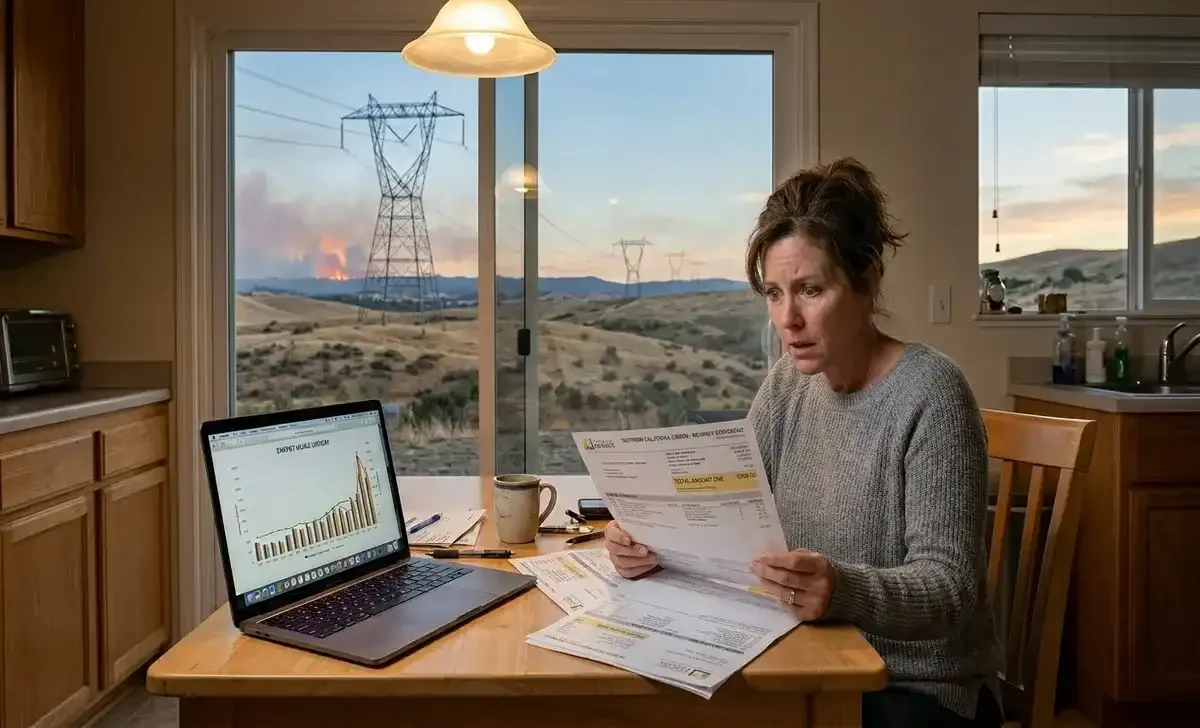
If your PG&E, SCE, or SDG&E bill has crept past $250 or $300 a month, you're not imagining it, and you're not alone. California's residential electricity rate now averages roughly $0.34–0.35 per kilowatt-hour, compared with a U.S. average of about $0.18/kWh — nearly 90% higher, according to the latest U.S. Energy Information Administration (EIA) data. Combined with rising natural gas costs, that puts California among the two or three most expensive states in the country for home energy, even though its per-household usage is lower than average thanks to a mild coastal climate.
Most residents know their bills are high. Far fewer understand why, which line items are negotiable, and which state programs could be cutting their bill by hundreds of dollars a year for free. This guide breaks down exactly what's driving costs, how to read your bill, and the specific actions that make a measurable difference.
Why California Utility Bills Are So High
There's no single culprit — it's five overlapping cost drivers stacking on top of each other:
- Wildfire liability and grid-hardening costs. Since the 2017–2018 fire seasons, utilities have been ordered to bury power lines, install weather stations, and clear vegetation buffers. The California Public Utilities Commission (CPUC) allows these costs to be recovered through customer rates, and they now represent one of the fastest-growing line items on the bill.
- Clean energy mandates. California's target of 100% clean electricity by 2045 requires large, ongoing investment in renewable generation and transmission, much of it funded by ratepayers.
- Aging grid infrastructure. A large share of the state's transmission and distribution equipment is decades old; replacing it is expensive and gets billed back to customers over time.
- Natural gas price exposure. Power plants that run on gas pass fuel costs through to electricity rates, and California sits at the end of long interstate pipeline routes, which makes it more sensitive to national supply shocks than states closer to production.
- Regulatory and public-purpose fees. State and local surcharges — wildfire funds, low-income assistance programs, energy-efficiency programs — typically add 15–25% on top of the base energy rate.
Global energy markets amplify some of this. Even a disruption thousands of miles away, such as tension around a critical shipping route like the Strait of Hormuz, can push up natural gas prices that eventually show up on a California gas bill a few months later.
How to Read Your Bill: Tiers, TOU, and Fixed Charges
Most California utilities now combine two pricing structures, and knowing which one applies to you changes how you should use electricity.
Tiered rates (baseline allowance)
- Tier 1 (baseline): A set monthly allowance of electricity at the lowest rate, sized for basic household needs.
- Tier 2: Everything above baseline is billed at a meaningfully higher rate — often 30–50% more per kWh.
Your baseline shifts by climate zone and season; inland desert areas get a larger summer allowance because air conditioning is treated as a necessity, not a luxury.
Worked example: A Fresno household with a 700 kWh Tier-1 baseline that uses 1,000 kWh in July is paying the higher Tier-2 rate on 300 kWh — the most expensive electricity they buy all month. Trimming usage by even 100 kWh removes that consumption entirely from Tier 2, which is why small cuts near the top of your usage often save more than the percentage would suggest.
Time-of-Use (TOU) plans
Under TOU pricing, the time you use electricity matters as much as how much:
| Window | Typical hours | Relative cost |
|---|---|---|
| Peak | 4 PM–9 PM, weekdays | Highest |
| Off-peak | Evening/early morning | Lower |
| Super off-peak | Late night/overnight (varies by utility) | Lowest |
TOU exists because grid demand spikes hard when everyone gets home and turns on the AC simultaneously. Utilities price that window higher to encourage people to shift usage. It's not unique to California — Singapore has faced a similar surge in cooling-driven peak demand as air conditioning use strains its grid, and utilities there are experimenting with comparable time-based pricing.
Practical shifts that actually save money on TOU:
- Run dishwashers, washers, and dryers after 9 PM
- Charge an EV overnight rather than after work
- Pre-cool the house to ~72°F before 4 PM, then let it coast through peak hours
- Use a smart thermostat that automatically follows the TOU schedule
TOU isn't automatically better for everyone. A household with a stay-at-home parent, a home office, or a medically necessary AC/medical device running all afternoon may do worse on TOU than on a standard tiered plan — model both before switching.
The Wildfire Surcharge, Explained
This is the line item that surprises the most people. After catastrophic wildfires linked to utility equipment, PG&E and other utilities were ordered to invest tens of billions of dollars in grid hardening — undergrounding lines, replacing wooden poles, and adding weather stations. The CPUC lets utilities recover those costs through wildfire-related surcharges, which can add roughly $10–$30 or more per month, depending on your utility and territory.
There's no direct opt-out, but ratepayers do have leverage:
- CPUC rate cases include public comment periods open to any Californian
- Consumer advocacy groups such as The Utility Reform Network (TURN) formally intervene in rate cases to challenge excessive charges
- You can file a formal complaint with the CPUC (cpuc.ca.gov) if you believe a charge is billed incorrectly
Natural Gas Bills: The Other Half of the Problem
Electricity gets the headlines, but gas bills have been just as brutal — winter 2022–2023 saw some SoCalGas and PG&E customers see bills triple within weeks. California's gas supply is tied to interstate pipeline markets, so national production dips or demand surges hit harder here than in states closer to the wellhead.
What to know:
- SoCalGas and PG&E dominate gas distribution statewide
- Bills spike in November through February with heating demand
- The state is actively pushing electrification — rebates exist for replacing gas water heaters, stoves, and furnaces with electric or heat-pump equipment through programs like Energy Upgrade California
- If your winter bill regularly exceeds $200–$300 for gas, an electrification rebate calculation is worth running before your next furnace replacement
Solar and Battery Storage Under NEM 3.0
Net metering (NEM 3.0), in effect since 2023, pays solar owners less for excess electricity exported to the grid than the previous program did. That's shifted the economics: self-consumption — using your own solar power directly instead of exporting it — now matters more than export credits.
- Electricity you generate and use yourself still saves at the full retail rate
- Exported electricity earns a lower "avoided cost" credit, not the retail rate
- Battery storage has become far more central to solar ROI, since it lets you shift your own solar power into evening peak hours instead of selling it cheaply and buying it back expensively
- A falling global price for lithium batteries — driven partly by manufacturing overcapacity in China — has been gradually pulling home battery prices down, making pairing solar with storage more affordable than it was even two years ago
- The federal solar Investment Tax Credit (30% as of this writing) still reduces upfront system cost significantly
Renters aren't locked out either: community solar programs let you subscribe to a share of a solar farm and receive bill credits without installing anything on your own roof.
CARE and FERA: The Most Underused Savings Program in the State
This is the single biggest missed opportunity for eligible households.
- CARE (California Alternate Rates for Energy): 20–35% discount on electric and gas bills for income-qualifying households
- FERA (Family Electric Rate Assistance): A smaller discount for larger households that earn slightly too much for CARE
Who qualifies:
- Households at or below 200% of the federal poverty level
- Anyone receiving Medi-Cal, CalFresh, SSI, WIC, or LIHEAP
- Many fixed-income seniors and low-income renters who've simply never applied
Applying takes about 10 minutes through your utility's website and can save $200–$500+ a year. Hundreds of thousands of eligible households never apply, often because they assume it's complicated — it isn't.
Regional Cost Differences: A Real Comparison
Geography changes your bill more than almost anything else you control:
| Region | Dominant cost driver | Typical summer bill impact |
|---|---|---|
| Inland valleys/desert (Fresno, Palm Springs) | AC load, May–Oct | Can push bills to $300–$450+ in peak summer months |
| Coastal (SF, San Diego) | Minimal cooling need, but fog reduces solar output | Lower electric bills, longer solar payback |
| Mountain regions | Winter heating, older/less-insulated housing stock | Gas bills dominate Nov–Mar |
Example: A 1,800 sq ft home in Fresno and an identically sized home in San Francisco can differ by $150+ a month in summer purely from cooling load — before either household changes a single habit.
Renters vs. Homeowners
- If you pay utilities directly: every program above (CARE, FERA, TOU, solar community programs) is available to you exactly as it is to homeowners.
- If utilities are bundled into rent: you have less direct control, but you can request that your landlord apply for CARE on the property, ask for a free utility-offered energy audit, and use a plug-in energy monitor to identify what's actually driving usage in your unit. California's AB 802 also requires many building owners to report whole-building energy use, which creates some pressure toward efficiency upgrades over time.
Practical Fixes Ranked by Return on Investment
| Fix | Approximate cost | Approximate annual savings |
|---|---|---|
| Smart thermostat | $100–$250 (rebates often available) | $100–$150 |
| Air-sealing/weatherstripping | $50–$100 | 10–15% off heating/cooling costs |
| Switching remaining bulbs to LED | $20–$50 | Ongoing, compounding |
| Smart power strips (kill "vampire draw") | $20–$40 | $50–$100 |
| Heat pump water heater | $1,500–$3,000 (before rebates) | 50–70% off water-heating costs |
| Battery storage with solar | $8,000–$15,000 (before 30% ITC) | Maximizes self-consumption savings |
Order matters. Sealing air leaks before replacing an HVAC system and weatherizing before adding a heat pump prevents you from paying to efficiently heat or cool air that's leaking straight back outside.
Common Mistakes That Cost Californians Money
Never compare rate plans. Utilities are required to show a rate-plan comparison on request — most customers never ask.
Not applying for CARE or FERA. This is the single largest source of "money left on the table."
Installing solar without modeling storage. Under NEM 3.0, solar-only systems return less than solar-plus-battery systems.
Running AC at a fixed temperature all day instead of scheduling around TOU peak hours.
Never actually read the bill. Billing errors happen; they're only caught by people who check line items.
Upgrading appliances before weatherizing. A high-efficiency heat pump in a poorly insulated home underperforms badly.
The Bottom Line
California's utility bills aren't high because of any one bad decision — they're the compound result of wildfire liability, an aging grid, an ambitious clean-energy transition, and a gas market exposed to national and global swings. None of that is something an individual household can fix. What is fixable is how much of that cost lands on you: choosing the right rate plan, applying for CARE or FERA if you're eligible, sealing your home before buying new equipment, and — if solar makes sense for your roof and climate zone — pairing it with storage rather than relying on export credits alone. Start with the free options (rate comparison, CARE application, a utility-offered energy audit) before spending money on equipment; they cost nothing and often make the biggest first-year difference.
Frequently Asked Questions
Why is my California electricity bill so much higher than those in other states?
A combination of wildfire-mitigation surcharges, clean-energy infrastructure investment, aging grid replacement costs, and state regulatory fees. California's residential rate (~$0.34–0.35/kWh) runs roughly 85–90% above the national average.
What's a normal monthly electric bill in California right now?
Estimates vary by source and usage level, but a typical single-family home lands somewhere between $200 and $260/month in 2026, with inland and desert homes running well above that in summer and coastal homes below it.
How do I know if I qualify for CARE?
If your household income is at or below 200% of the federal poverty line, or if anyone in the household receives Medi-Cal, CalFresh, SSI, WIC, or LIHEAP, you likely qualify. Apply directly on your utility's website — it takes about 10 minutes.
Is solar still worth it under NEM 3.0?
Generally, yes, especially paired with battery storage, since self-consumption at retail rates is worth far more than the reduced export credit. The 30% federal tax credit still meaningfully lowers the upfront cost.
Can I dispute a bill I think is wrong?
Yes. Start with your utility's customer service. If it's unresolved, you can file a formal complaint with the California Public Utilities Commission (CPUC), which regulates PG&E, SCE, and SDG&E.
Does switching to a Time-of-Use plan always save money?
No. It helps households that can shift laundry, EV charging, and AC pre-cooling away from 4–9 PM. It can cost more for households with high, fixed afternoon usage — model your own bill under both plans before switching.