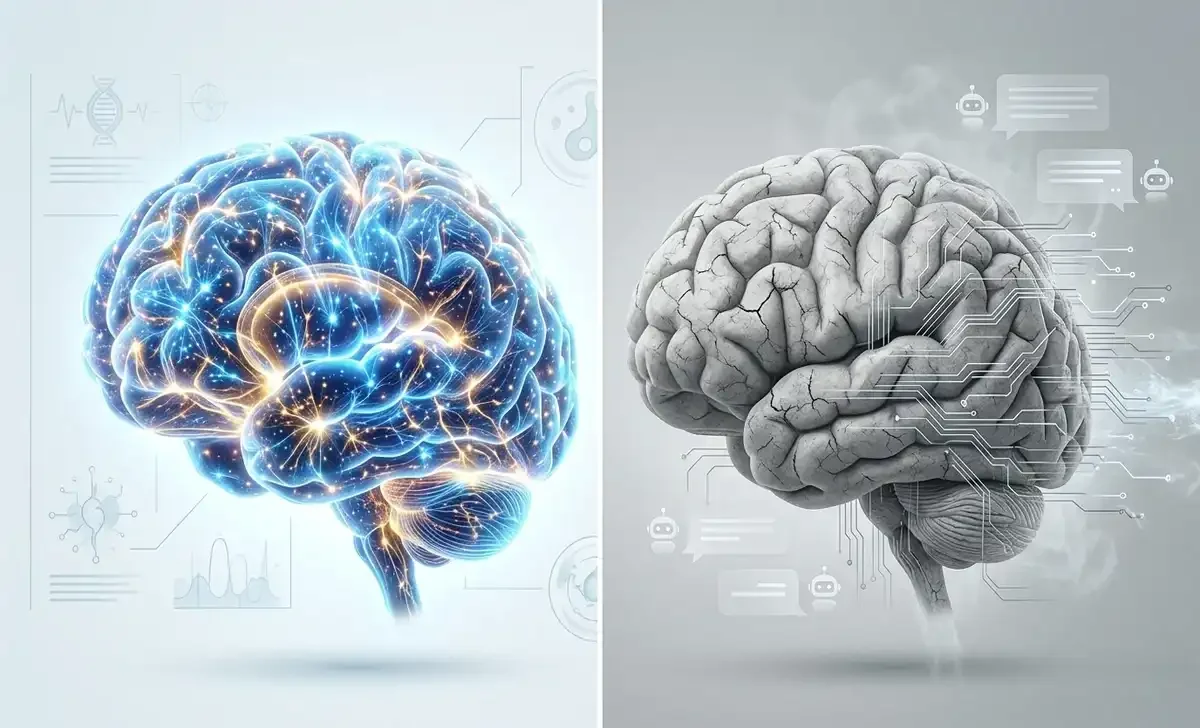
If you use AI tools every day, you may have noticed something unsettling: you forget things faster, you struggle to focus without a prompt window open, and you reach for a chatbot before you've even tried to think a problem through yourself.
This pattern has picked up an informal name online — "AI brain damage." It isn't a clinical diagnosis, but the mechanism behind it is real and well studied: when a task can be handed off to an external system, the brain has less reason to build or maintain the pathways needed to do that task unassisted. Cognitive scientists have been documenting this kind of "use it or lose it" effect in memory and attention research for decades; AI tools have simply made the offloading faster, broader, and easier to reach for than any tool before them.
This guide breaks down what's actually happening in the brain, the warning signs worth taking seriously, and ten concrete, research-grounded habits that let you keep the productivity benefits of AI without quietly losing your own cognitive edge.
What Is "AI Brain Damage"? (And Is It Real?)
There's no ICD code for "AI brain damage," and no single study proves that AI use damages the brain the way an injury would. What's real is the underlying process: cognitive offloading — delegating memory, calculation, writing, or reasoning to an external system.
Humans have always offloaded cognition to some degree; writing something down is offloading. What's different with generative AI is scale and scope. A notebook stores what you have already thought. An AI tool generates the thought for you, across nearly every cognitive domain — memory, writing, analysis, decision-making — simultaneously.
The classic reference point here is the "Google Effect," documented by psychologist Betsy Sparrow: people are measurably less likely to commit information to long-term memory when they expect to be able to look it up again. Generative AI plausibly extends this effect further, since it doesn't just store information — it produces finished answers, so there's even less reason to engage with the material at all.
The result is a feedback loop: the less you exercise a cognitive skill, the weaker it gets, which makes you more reliant on AI to cover for it, which further reduces your practice — and so on.
Warning signs worth paying attention to:
- Trouble concentrating on one task for more than a few minutes without checking a device
- Reaching for AI before attempting any independent thought
- Forgetting information or skills you used to know well
- Feeling anxious or "stuck" when AI tools are unavailable
- A noticeable drop in confidence in your own judgment or problem-solving
If several of these sound familiar, the strategies below are worth taking seriously — not as a reason to quit AI, but as a way to keep your own thinking muscles active alongside it.
How to Rebuild Cognitive Resilience While Still Using AI
Reclaim Your Memory Intentionally
Memory isn't passive storage — it's an active system strengthened through retrieval, not just exposure. Every time you skip the effort of recalling something because AI can surface it instantly, you skip the retrieval practice that makes memory durable.
What to do:
- Use spaced-repetition tools (e.g., Anki) for information you actually want to retain
- Give yourself 60 seconds to try to recall something before asking AI
- Keep a running journal of ideas and decisions you want to internalize, in your own words
Example: A developer who used to know common syntax from memory finds himself blanking without autocomplete after months of AI-assisted coding. Instead of quitting AI tools, he spends 10 minutes each morning reviewing flashcards of patterns he wants to own mentally — recovering fluency without giving up the workflow.
Set Hard Usage Limits
Willpower doesn't hold up well against tools engineered for frictionless engagement. Structure works better than intention.
Limits worth trying:
- No AI for tasks that take under 10 minutes to do manually
- AI-free mornings — the first two hours of the workday, no prompting
- One fully AI-free day per week
- Screen-time tools to track and cap daily AI usage
Example: A writer who now freezes in front of a blank page without an AI-generated outline commits to AI-free mornings three days a week. Within a few months, she can draft from scratch again, and her confidence in her own ideas improves alongside it.
Practice Deep Reading Daily
AI makes it trivial to get a summary of any book, paper, or article. But deep reading is itself a cognitive workout, not just a way of transferring information — it builds sustained attention, trains you to follow complex arguments, and strengthens vocabulary and nuance in ways a bullet-point summary can't.
What to do: Read at least 20 uninterrupted minutes daily — physical books or substantial long-form writing. Take notes in your own words. Resist the urge to check a summary before or after. A book club adds useful accountability.
Write by Hand
Handwriting engages more complex neural coordination than typing, and considerably more than dictating to an AI. When you hand a first draft to an AI tool, you're not just saving time — you're skipping the labor of organizing thought and choosing words, which is where a meaningful share of actual thinking happens.
Ways to reintegrate it:
- Morning pages: three handwritten pages before touching a screen
- Handwrite first drafts of important documents before digitizing them
- Take meeting notes in a physical notebook
- Write an actual letter to someone occasionally
Apply the "Try First" Rule to Every Problem
One of the more corrosive habits AI enables is pasting a problem into a chat window the instant it gets hard, skipping the productive struggle where real competence is built.
The rule: Spend 10–15 minutes attempting any problem independently before opening an AI tool. Write down what you tried and where you got stuck. Use AI as a thinking partner from there — and afterward, make sure you can explain the solution back in your own words.
Example: A data analyst stopped writing SQL from scratch because AI handled it, and within six months, couldn't diagnose a broken query without help. She reinstated a personal rule — attempt every query unassisted for at least 10 minutes — and recovered her diagnostic skills within two months.
Rebuild Your Attention Span Deliberately
AI fragments attention two ways: it delivers instant answers that remove the experience of sustained thinking, and it's available on every device, inviting constant context-switching.
Ways to rebuild focus:
- Pomodoro-style blocks: 25–50 minutes of single-task work, no switching
- Remove AI chat apps from your phone's home screen
- Practice sitting with boredom for five minutes with no stimulus — genuinely harder than it sounds, and that difficulty is diagnostic
- Delay notification responses instead of answering instantly
Digital habit-tracking and intentional-use tools have become their own category for exactly this reason, and it's worth treating your AI usage with the same scrutiny people increasingly apply to compulsive app and screen habits more broadly — the underlying attention mechanics are the same.
Prioritize Real Human Conversation
AI conversation is always available, endlessly patient, and never difficult. Human conversation is messier and more demanding — and that difficulty is exactly what makes it cognitively and emotionally rich. Reading nonverbal cues, navigating disagreement, and building rapport all exercise capacities that a chatbot simply doesn't have.
What to do: Have at least one unscripted conversation with another person daily. Don't use AI to script social interactions in advance. Put devices away during meals and meetings.
Learn One New Skill Without AI Assistance
Real learning happens through struggle, error, and revision — what cognitive scientists call "desirable difficulties," where making learning intentionally harder makes it stick better. AI, by removing friction, can quietly remove the growth mechanism along with it.
How to apply this: Pick one skill to learn the traditional way — books, deliberate practice, a human teacher if possible. If it's a language, use structured practice apps rather than leaning on AI translation. If it's a course, write your own notes rather than summarizing lectures with AI.
Exercise Regularly
This isn't a tangent — physical exercise is one of the most evidence-backed cognitive interventions available. It raises levels of BDNF (brain-derived neurotrophic factor), which supports neuron growth and synaptic maintenance. Heavy AI users skew sedentary — sitting, typing, prompting — and that combination of physical inactivity and passive mental engagement compounds the problem.
Minimum effective dose: 30 minutes of moderate cardio, five days a week. Take walking breaks during demanding cognitive work. Activities combining physical and mental engagement — dancing, martial arts, climbing — offer extra benefit. Leave your phone behind occasionally and let your mind wander unprompted.
Conduct a Regular AI Dependency Audit
Most people don't realize how dependent on AI they've become until they try to function without it. A monthly audit builds honest awareness before the gap grows too wide.
Monthly checklist:
- Which tasks did I use AI for this month?
- Which of those could I have done myself with reasonable effort?
- Am I less capable at anything than I was six months ago?
- Am I using AI to think, or instead of thinking?
- Does my AI usage make me more or less confident in my own abilities?
Common Mistakes to Avoid
- Going cold turkey too fast. Sudden AI withdrawal tanks productivity and creates unnecessary friction. Scale back gradually and strategically instead.
- Treating all AI use as equivalent. Automating rote administrative work is categorically different from outsourcing your thinking. The former preserves cognitive capacity; the latter erodes it.
- Ignoring emotional dependency. Some people lean on AI mainly for validation, emotional processing, or companionship — a distinct dependency with its own risks, separate from cognitive offloading.
- Assuming children are less vulnerable. Kids and teens are forming their cognitive baselines during the AI era, and the case for caution is arguably stronger for them than for adults — a concern that echoes the broader debate around age-based restrictions on other high-engagement digital products.
- Confusing speed with intelligence. Finishing tasks faster with AI doesn't mean your underlying cognitive capacity is improving — often, the opposite is happening beneath the surface.
How to Tell If It's Working
Recovery isn't abstract — it shows up in specific, checkable ways:
- You can start a piece of writing or a problem from a blank page without immediately opening an AI tool
- You notice you're recalling facts, names, or steps you'd normally have looked up
- A 25–50 minute focus block feels manageable rather than uncomfortable
- You feel calm, not anxious, in situations where AI isn't accessible
Track these the same way you'd track any other health metric — informally, monthly, and honestly.
Conclusion
AI tools are genuinely useful, and nothing here is an argument for avoiding them. The goal is narrower: use them without letting them use you.
The ten strategies above share one underlying principle — memory, attention, problem-solving, creativity, and social connection are all use-dependent systems. Hand them off entirely to AI, and they weaken. Keep exercising them — even slowly, even imperfectly — and they stay strong.
Pick one change to start this week. Apply the Try First rule to your next hard problem. Read for 20 minutes without checking a summary afterward. Write something by hand. The friction you feel doing these things isn't inefficiency — it's your brain doing exactly what it evolved to do. That's worth protecting, especially as automation keeps expanding into physical work once done by humans — making the case for staying mentally, not just physically, sharp even stronger.
FAQs
Is "AI brain damage" a real medical condition?
No — there's no formal diagnosis. But the underlying mechanisms are real and documented: cognitive offloading, weaker memory encoding, reduced sustained attention, and declining confidence in independent problem-solving. The term is informal shorthand for a legitimate, measurable pattern rather than a diagnosis.
How much AI use is too much?
There's no universal threshold or hours-per-day cutoff. The better question is functional: has your independent focus, memory, or problem-solving actually declined? If you struggle to concentrate without AI, forget things you used to know, or feel anxious when it's unavailable, that's a stronger signal than any usage number.
Can the effects be reversed?
Generally, yes. The brain remains plastic across most of adulthood. Deliberate memory retrieval, deep reading, unassisted problem-solving, and sustained-focus practice can rebuild weakened pathways over weeks to months — this isn't a one-way deterioration for most people.
Is it harmful to use AI for creative work?
It depends on how it's used. Using AI to break a block or stress-test an idea keeps your own creative reasoning engaged. Having AI generate finished creative work wholesale and presenting it as your own skips the practice that makes creative skill durable in the first place.
Are some AI tools riskier than others for cognitive offloading?
Broad conversational tools that can write, analyze, plan, and reason carry more offloading risk than narrow single-purpose tools like a spell-checker or GPS, simply because they cover more cognitive territory. The wider the tool's reach, the more deliberate you need to be about which parts of your thinking you keep doing yourself.
How long before I notice improvement after cutting back?
Most people report better focus and memory confidence within two to four weeks of consistent practice. Deeper gains — in independent problem-solving and sustained creative output — tend to show up over two to three months.
Does this apply differently to students or knowledge workers?
The mechanism is the same, but the stakes differ. Students are still building foundational skills and baselines, so unassisted practice matters more for them long-term. Knowledge workers with already-established expertise have more room to offload routine tasks safely, provided they keep exercising the judgment-heavy parts of their work themselves.