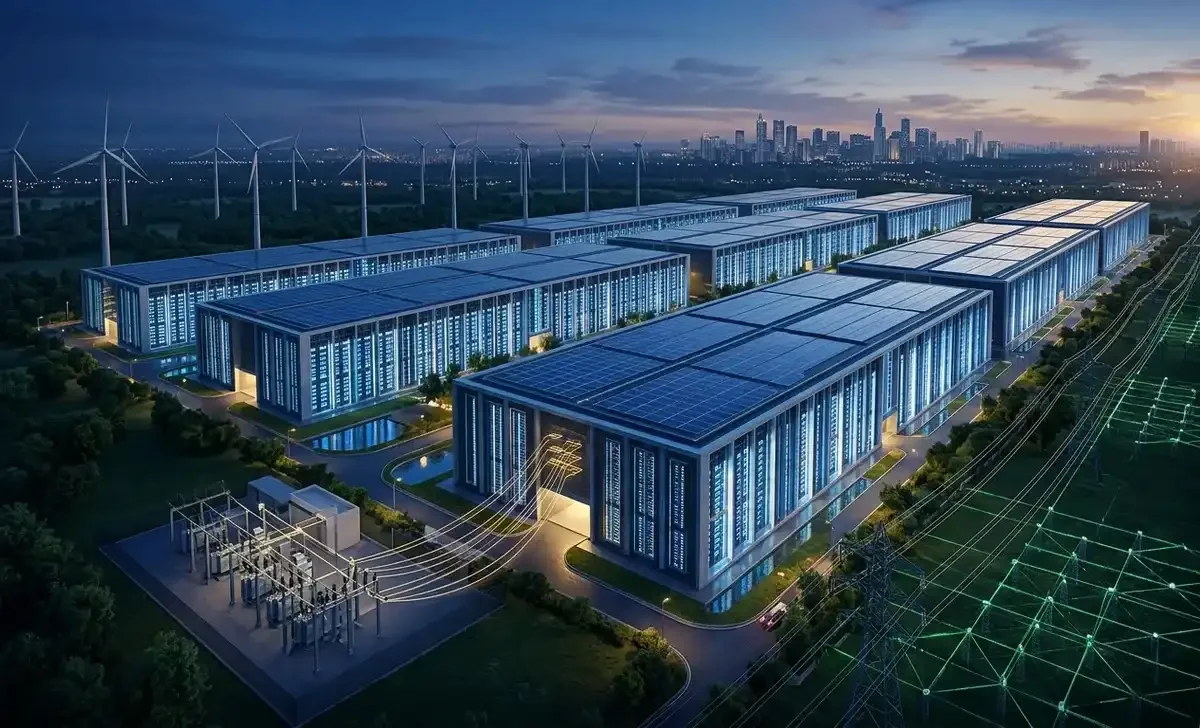
Adani Group is best known for ports, airports, and power. But its quietest bet may turn out to be its biggest: a $100 billion commitment to build India's AI computing backbone by 2035. In February 2026, Adani Group formally pledged that sum to expand AdaniConneX — its data centre joint venture — from roughly 2 gigawatts (GW) of capacity today to 5GW, with renewable power baked into every facility from day one.
That commitment didn't appear out of nowhere. AdaniConneX already has a confirmed ~$15 billion partnership with Google for what's being built as India's largest AI infrastructure hub, in Visakhapatnam. And as of March 2026, Adani is in fresh talks with Meta and with Walmart's Flipkart to expand further, while rivals like Reliance Industries and Tata Consultancy Services race to lock in their own multi-billion-dollar data centre deals.
This guide breaks down what AdaniConneX actually is, where the money and the megawatts are going, how it stacks up against competitors, and what the next 24 months are likely to look like — with sourced figures and a practical walkthrough of how a deal like this actually comes together.
What Is AdaniConneX?
AdaniConneX is a 50-50 joint venture between Adani Enterprises and EdgeConneX, an established U.S. data centre operator, formed in 2021. EdgeConneX supplies global operating experience and hyperscale client relationships; Adani supplies land, captive renewable power generation, and construction capacity at a speed few competitors can match.
That combination — land, power, and build capability under one roof — is the company's core thesis. In most markets, each of those is a separate bottleneck handled by a separate vendor. AdaniConneX controls all three, which is why hyperscalers keep showing up at the negotiating table.
Where things stand in 2026:
- Current operating capacity: roughly 2GW nationally
- Target by 2035: 5GW, described internally as part of a "five-layer AI stack" spanning power, land, data centres, networking, and AI services
- Capital commitment: $100 billion, announced February 2026
- Parallel investment: over $50 billion earmarked for clean energy and battery storage to feed these facilities
A Quick Timeline: How AdaniConneX Got Here
Understanding the trajectory matters more than any single headline. Here's the practical sequence:
| Period | Milestone |
|---|---|
| 2021 | AdaniConneX launches; first partnership signed with Flipkart for a Tier IV facility in Chennai |
| 2023–2024 | Mumbai, Chennai, Noida, and Hyderabad campuses come online or break ground |
| Late 2025 | AdaniConneX and Google formally announce a ~$15 billion, multi-year investment to build a gigawatt-scale AI hub in Visakhapatnam — three campuses, developed alongside Nxtra by Airtel. |
| February 2026 | Adani Group commits $100 billion to AI-ready data centres by 2035, targeting 5GW of capacity. |
| March 2026 | Bloomberg reports Adani is in fresh, preliminary talks with Meta and Google for additional partnerships beyond existing commitments; Walmart's Flipkart is also negotiating an expanded, AI-focused second facility. |
This timeline matters for one reason: it shows the difference between an announced commitment (the Google deal, the $100B pledge) and an exploratory talk (the newer Meta and expanded-Flipkart discussions). Conflating the two is the single most common mistake in coverage of this story.
Why Meta, Google, and Flipkart Keep Coming Back to Adani
Four structural pressures are pushing tech giants toward Indian infrastructure partners generally, and Adani specifically:
- Scale of the market. India has over 900 million internet users, with AI adoption and cloud demand both accelerating faster than domestic data centre capacity.
- Data localisation rules. Certain categories of data must legally stay within India's borders, which forces companies to build or rent local capacity rather than serve India from overseas regions.
- Latency for AI workloads. AI inference and training perform best when compute sits physically close to users — every hundred miles of fibre adds delay.
- Permitting friction. Land acquisition and power permitting in India can take years when done independently. Adani's model bundles land, power, permits, and construction into a single deal, which is exactly why the Google partnership moved from announcement to construction relatively quickly.
This aligns with broader global AI demand trends pushing hyperscalers to secure compute capacity in every major emerging market, not just Western hubs. Google's confirmed Visakhapatnam investment — and the renewed Meta and Flipkart conversations — are direct evidence of that trend playing out in India specifically.
Worth noting: representatives for Adani, Meta, and Walmart have all declined to comment publicly on the newer talks, and Google has stated it has no new investments to announce beyond the existing Visakhapatnam project. Treat the Meta and expanded-Flipkart discussions as preliminary until a contract is confirmed.
India's Data Centre Market, By the Numbers
- India's data centre market was valued at roughly $5–6 billion in 2024
- Projected to reach $15 billion or more by 2030, growing at a double-digit compound annual rate
- Demand drivers: cloud adoption tripling in the corporate sector over three years, 5G-driven edge computing needs, AI use cases in healthcare, finance, agriculture, and retail, and continued growth of OTT/streaming platforms
- National policy backdrop: India has a stated goal of 500GW of non-fossil-fuel power capacity by 2030, which directly shapes how data centres are expected to source electricity
Visakhapatnam, Mumbai, Chennai, and Hyderabad currently account for the bulk of hyperscale activity, but demand is outpacing supply in all of them, which is exactly the gap AdaniConneX is built to fill.
Where AdaniConneX Is Building
| Location | Why It Matters |
|---|---|
| Visakhapatnam | Site of the flagship Google-backed AI hub — three planned campuses, gigawatt-scale, built alongside Nxtra by Airtel |
| Mumbai / Navi Mumbai | India's financial capital and primary internet gateway, with the highest baseline demand in the country |
| Chennai | South India's tech hub; access to submarine cable landing stations; site of the original Flipkart Tier IV facility |
| Hyderabad | Existing tech ecosystem (Microsoft, Google, Amazon, Apple offices already present). Microsoft has been aggressively expanding its own data centre footprint globally, making its Hyderabad presence a useful benchmark for the enterprise demand that AdaniConneX is positioning to serve |
| Noida / NCR | Serves North Indian corporate demand; growing secondary hub |
| Pune | Mumbai's overflow market; improving power infrastructure, strong local IT sector |
What Makes AI Data Centres Different
A standard cloud data centre and an AI training facility are not the same product. AI-ready infrastructure requires:
- Roughly 3x more power per server rack than conventional cloud facilities
- Liquid cooling systems to manage GPU heat loads that air cooling can't handle
- Ultra-low-latency fibre connectivity between GPU clusters
- Dedicated GPU cluster configurations, often customized per client workload
Next-generation AI-optimised CPUs and accelerators are redefining what data centre design has to accommodate — from power density per rack to physical spacing between racks for cooling and cabling. This is the technical reason AdaniConneX frames its roadmap as a "five-layer AI stack" rather than just server space: power generation, land, the physical data centre, networking, and AI-specific services all have to be engineered together, not bolted on afterward.
A Practical Example: How a Hyperscaler Actually Evaluates a Deal Like This
It helps to walk through what "talks" actually involve, using the confirmed Google–AdaniConneX deal as the model:
- Capacity and timeline assessment. Google needed gigawatt-scale capacity for AI workloads in India within a multi-year build window. AdaniConneX could commit to that scale because it already controlled land and renewable generation in Visakhapatnam — most independent operators couldn't make that commitment without years of additional permitting.
- Power sourcing verification. Google's infrastructure partnerships carry strict sustainability requirements. AdaniConneX's ability to point to Adani Green Energy's existing solar and wind capacity — rather than a future promise — was a deciding factor.
- Site selection. Visakhapatnam was chosen partly for land availability and partly for its role in the broader push to decentralize India's data centre map beyond Mumbai and Chennai.
- Structuring the investment. The arrangement combines direct capital commitment (~$15 billion) with joint development alongside a second partner (Nxtra by Airtel) — spreading construction risk across multiple operators building adjacent campuses.
- Public confirmation. Only once contracts were signed did the companies make a joint announcement — the gap between "talks" and "deal" in this case ran from initial discussion to public confirmation over roughly a year.
The same five steps are playing out now with Meta and with Flipkart's expanded facility — they're simply earlier in the sequence (steps 1–2) rather than at step 5.
Competitive Landscape
| Company | Key Strength | Notable Weakness |
|---|---|---|
| AdaniConneX | Vertical integration: land, power, construction in-house | Newer entrant relative to global operators |
| Reliance (Digital Connexion) | $11 billion Visakhapatnam deal signed in late 2025; strong balance sheet | Less international hyperscale track record |
| Tata Consultancy Services | $1 billion raised from TPG to accelerate buildout | Smaller absolute scale so far |
| NTT Data Centres | Global brand, established enterprise relationships | Less India-specific land/power advantage |
| CtrlS | India-first, Tier IV certified | Limited hyperscale capacity vs. larger entrants |
| Nxtra (Airtel) | Telecom backbone integration; co-developing the Visakhapatnam hub | Power reliability has historically been a challenge |
| STT GDC India | Singapore-backed, well-funded | Limited renewable energy integration |
Adani's edge remains vertical integration — owning the power source removes a cost and timeline variable that every competitor still has to negotiate separately.
Sustainability: Adani's Strongest Card
A single hyperscale facility can consume as much electricity as 50,000 homes, which makes power sourcing a regulatory and commercial issue, not just an environmental one. AdaniConneX has committed to powering all new facilities with 100% renewable energy sourced from Adani Green Energy's solar and wind portfolio, backed by the group's parallel $50 billion-plus investment in clean energy and battery storage. For clients like Google and Meta — both of which audit suppliers on sustainability — that's a structural advantage, not a marketing line.
The open question is water: liquid-cooled AI facilities consume significant water for cooling, and in water-stressed Indian regions, this is becoming a real regulatory and community-relations risk that hasn't been fully resolved industry-wide.
What This Means for Investors and Businesses
Direct exposure: Adani Enterprises and Adani Green Energy are publicly listed and stand to benefit from data centre expansion. AdaniConneX itself remains a private joint venture, though an eventual IPO is widely expected as the platform scales toward its 5GW target.
Indirect exposure: networking and cooling equipment suppliers, commercial real estate near established corridors (Visakhapatnam, Mumbai, Chennai), and power infrastructure firms serving the sector.
Risks to watch: regulatory and land-acquisition delays remain common in Indian infrastructure; tech company capex can shift with global macro conditions; competition from Reliance and TCS could compress margins; and water usage for cooling is an unresolved regulatory variable.
Expert Tips for Following This Story
- Separate MOUs from signed contracts. The Google deal is signed and under construction. The Meta and expanded-Flipkart talks, as of March 2026, are not.
- Power is the real bottleneck, not land or permits — operators who control generation, like Adani, have a structural head start.
- Check distance to internet exchange points when evaluating any specific site; it directly determines latency for end users.
- Watch India's Digital India Act and data localisation rules — they will determine which categories of data must legally stay on Indian soil, directly affecting demand.
- Don't treat this as a Tier-1-cities-only story. Visakhapatnam itself was a secondary city before this round of investment; Pune, Ahmedabad, and other Tier 2 hubs are seeing real demand growth too.
Conclusion
The Adani data centre story has moved well past the speculative stage. A confirmed, multi-billion-dollar Google partnership is already under construction in Visakhapatnam, backed by a public $100 billion, 5GW commitment through 2035 — and renewable power, not just land, is what's letting Adani move faster than most competitors. What's still unresolved is the next layer: whether the Meta talks and Flipkart's expanded AI facility convert from exploratory conversations into signed deals, and how the water and regulatory questions around AI-scale cooling get resolved as the buildout accelerates. For now, the safest read is to treat the Google deal as fact and everything else — Meta, the expanded Flipkart facility, and any new city announcements — as still in motion.
FAQs
Is Adani's data centre deal with Meta confirmed?
No. As of March 2026, talks between Adani and Meta are described as preliminary and exploratory by Bloomberg's sourcing; no contract has been signed or publicly confirmed by either company.
Has Adani signed anything with Google?
Yes. AdaniConneX and Google have a confirmed partnership, reported at roughly $15 billion, to build a gigawatt-scale AI infrastructure hub in Visakhapatnam, alongside Nxtra by Airtel. The newer 2026 talks with Google are a separate, additional phase beyond that existing commitment.
How big is AdaniConneX's capacity right now?
AdaniConneX operates roughly 2GW of national data centre capacity as of early 2026, with a stated target of 5GW by 2035 backed by a $100 billion investment commitment announced in February 2026.
Why is Visakhapatnam the focus instead of Mumbai or Chennai?
Land availability and a deliberate push to decentralize India's data centre map beyond the traditional Mumbai-Chennai corridor. It's also where the confirmed Google partnership is being built at a gigawatt scale.
What does EdgeConneX actually contribute?
International operating standards, technical expertise, and existing hyperscale client relationships. Adani contributes land, captive renewable power, regulatory navigation, and construction speed.
Will these data centres run on renewable energy?
AdaniConneX's stated policy is 100% renewable power for all new facilities, sourced from Adani Green Energy's solar and wind assets, supported by a parallel $50 billion-plus clean energy and battery storage investment.
How does Adani compare to Reliance and TCS in this race?
Reliance signed an $11 billion data centre deal in Visakhapatnam through its Digital Connexion venture in late 2025, and TCS raised $1 billion from TPG to accelerate its own buildout. AdaniConneX remains larger by committed capital and capacity target, but competition is intensifying quickly.