The United States has not faced a successful military strike on its homeland since World War II. Golden Dome is the Trump administration's answer to a threat environment that officials say has changed faster than U.S. defenses have: nuclear-armed rivals now field hypersonic weapons that no existing American system can reliably stop.
It's also, as of mid-2026, the subject of the loudest public fight inside the Pentagon in a decade — a dispute over whether the program will cost $185 billion or something closer to $1.2 trillion. That gap alone tells you how early-stage and unsettled this program still is.
This guide covers what Golden Dome actually is, how it's supposed to work, who's building it, what it costs (and why nobody agrees on that number), and where the real controversy lies — with sourcing throughout, not just headline claims.
What Is Golden Dome?
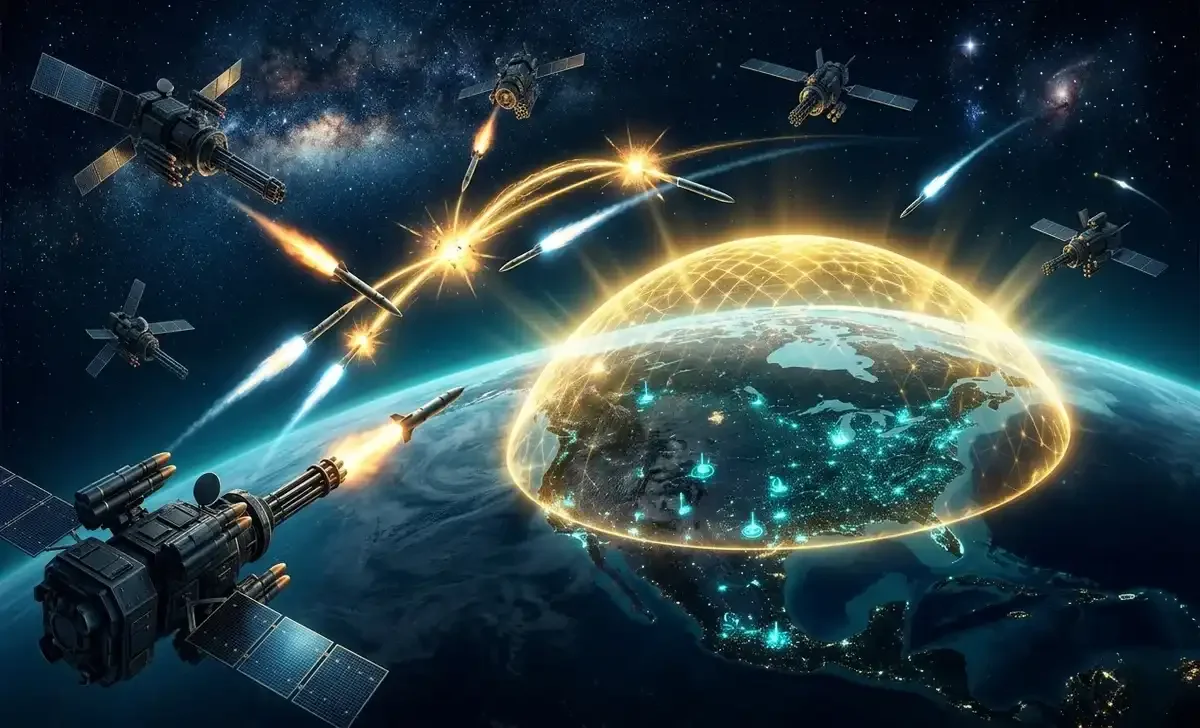
Golden Dome is a planned "system of systems" for U.S. homeland missile defense: a layered network of ground-, air-, sea-, and space-based sensors and interceptors meant to detect and destroy incoming ballistic missiles, hypersonic glide vehicles, and advanced cruise missiles before they reach American territory.
It began life under a different name. President Trump signed Executive Order 14186, "The Iron Dome for America," on January 27, 2025 — one week into his second term. The program was renamed Golden Dome soon after, partly to distinguish it from Israel's much smaller-scale Iron Dome. The comparison is more marketing than engineering: Iron Dome defends a territory roughly the size of New Jersey from short-range rockets fired a few dozen miles away. The Golden Dome is meant to defend an entire continent against intercontinental missiles and maneuvering hypersonic weapons traveling thousands of miles.
The executive order directs the Pentagon to defend U.S. citizens and infrastructure against "any foreign aerial attack on the Homeland" — a notable shift from prior missile-defense policy, which focused mainly on deterring rogue-state and accidental launches while relying on nuclear deterrence against China and Russia.
The program is officially led by Gen. Michael Guetlein of the U.S. Space Force, confirmed by the Senate in mid-2025, with Dr. Douglas Matty named in January 2026 to head day-to-day project execution.
How Golden Dome Is Supposed to Work
The strategic idea behind Golden Dome is boost-phase intercept — destroying a missile in the first three to five minutes after launch, while it's still relatively slow, hasn't deployed decoys, and hasn't separated into multiple warheads. Existing systems like THAAD and Patriot instead intercept missiles in the terminal phase, which is the hardest shot: the target is moving fastest and may already be surrounded by countermeasures.
The envisioned sequence:
- A space-based infrared sensor detects a missile launch within seconds of ignition, based on its heat signature.
- Onboard or ground-based tracking software calculates the missile's likely trajectory almost immediately.
- A space-based interceptor — a small kinetic-kill vehicle carried on an armed satellite — is launched to physically collide with the missile at high speed, destroying it without an explosive warhead.
- Each interceptor satellite would ideally carry multiple kill vehicles, since a single missile launch can't be predicted to occur near any one satellite's location at any given time.
A practical example of the engineering problem: because satellites carrying interceptors orbit in a fixed path, and a missile could launch from almost anywhere on Earth, a dense constellation is required so that an interceptor is always within reach of a potential launch site. This is why the Congressional Budget Office's (CBO) notional design calls for 7,800 satellites — not because more is inherently better, but because coverage math demands it. It's also why these satellites need to be low enough in orbit (roughly 300–500 km) to reach a missile in time, which means atmospheric drag limits each satellite's working life to about five years, requiring the constellation to be continuously replenished.
The AI and computing demands of this pipeline are substantial: identifying a real ICBM launch versus a false alarm, tracking multiple simultaneous launches, and firing on the correct target — all within a few minutes — requires processing and decision speeds far beyond what most current air-defense software handles today. Some of the same underlying compute demand is discussed in the context of how AI infrastructure needs are scaling across government and industry.
Who's Building Golden Dome
Unlike a traditional single-contractor weapons program, Golden Dome is being built through dozens of parallel contracts split between legacy defense primes and newer space and defense-tech startups — a deliberate Pentagon strategy to combine acquisition experience with faster-moving technical risk-taking.
Confirmed contractors and roles as of mid-2026:
- SpaceX — Awarded a reported $2 billion contract (October 2025) to help build a roughly 600-satellite constellation for missile tracking and targeting, later followed by additional Space Force awards, including a $4.16 billion contract (May 2026) for a sensing-and-tracking satellite constellation and a $2.29 billion contract for a "Space Data Network" backbone. SpaceX's involvement has drawn scrutiny over conflicts of interest, since senior officials with ties to the company — including the Space Development Agency's founder — have played roles in shaping the program.
- Anduril Industries — Received an early Space Force contract to develop space-based interceptor prototypes and, in March 2026, acquired ExoAnalytic Solutions, adding a global network of more than 400 telescopes used for satellite tracking and missile detection.
- Lockheed Martin — Building on its existing Next-Generation Interceptor (NGI) program for ground-based midcourse defense, the company said in early 2026 it would open its first dedicated NGI production plant and roughly triple annual output of PAC-3 (Patriot) interceptors.
- Northrop Grumman, True Anomaly, and Impulse Space — All reported among the roughly dozen firms awarded prototype development contracts for interceptor and satellite-servicing components.
- 12 companies total were selected by Space Systems Command in April 2026 through 20 "Other Transaction Authority" agreements worth up to $3.2 billion combined, specifically to develop competing space-based interceptor concepts intended for initial integration by 2028.
Guetlein has been explicit that space-based interceptors are not guaranteed to survive into the final architecture: if the technology proves too expensive or unable to scale, the Pentagon says it will drop that layer rather than build something unaffordable.
What Will Golden Dome Actually Cost?
This is the single most contested number in the program, and the disagreement is now public and heated.
| Source | Estimate | Basis |
|---|---|---|
| Trump administration (May 2025) | $175 billion | Original public announcement |
| Pentagon / Gen. Guetlein (2026) | $185 billion | Over ~10 years; revised up to cover added space-sensor requirements |
| Congressional Budget Office (May 2026) | $1.2 trillion | Over 20 years, based on a "notional" architecture built from the executive order's stated goals, since the Pentagon hasn't released its actual objective design |
| CBO (space-based interceptors removed) | $448 billion | If the program drops the orbital kill-vehicle layer entirely |
| American Enterprise Institute (independent) | $250 billion–$2.4 trillion | Wide range reflecting how much the final cost depends on space-based interceptor scope |
The CBO's math is instructive: of its $1.2 trillion estimate, roughly $1 trillion is acquisition cost, and the space-based interceptor constellation alone accounts for about 70% of that — roughly $720–743 billion over 20 years, driven by the need to keep replacing short-lived satellites.
Guetlein has publicly rejected the CBO figure, arguing the agency modeled a "legacy," early-2000s-style architecture rather than the newer, more compute- and sensor-driven approach the Pentagon says it's actually pursuing. CBO, for its part, notes it had no choice but to estimate a notional system, since the Pentagon hasn't publicly released its real "objective architecture" — the specific mix and count of systems it intends to field. Critics, including budget watchdogs and members of Congress, argue that even $1.2 trillion may understate the true cost, since a fully space-based-interceptor shield sized to counter Russia's and China's arsenals could require satellite-to-missile ratios far higher than CBO assumed.
Funding so far: Congress has funneled money into the program mainly through the 2025 reconciliation law (the "One Big Beautiful Bill Act"), which provided $24.4 billion for Golden Dome-related efforts, including $18.8 billion earmarked specifically for next-generation technologies like space-based sensors and boost-phase interceptors. The FY2026 defense appropriations bill added a further $13.4 billion for related space and missile defense systems, and the Pentagon has requested roughly $17.5–17.9 billion more for fiscal year 2027.
For comparison, the F-35 fighter program — the most expensive weapons program in U.S. history to date — has cost over $400 billion and counting. Golden Dome's low-end estimate alone is roughly half that; its high-end estimate is several times larger.
Golden Dome Timeline
| Date | Milestone |
|---|---|
| January 27, 2025 | Trump signs EO 14186, "The Iron Dome for America" |
| May 20, 2025 | Trump publicly announces a $175B cost target and a 3-year completion goal |
| July 2025 | Gen. Michael Guetlein confirmed by the Senate to lead the program |
| July 2025 | One Big Beautiful Bill Act signed, providing $24.4B for the program |
| November 2025 | First (reportedly classified) prototype interceptor contracts awarded |
| January 2026 | Dr. Douglas Matty named to head day-to-day project execution |
| February 2026 | FY2026 defense appropriations add $13.4B for related systems |
| March–April 2026 | Anduril acquires ExoAnalytic Solutions; Space Force selects 12 companies for interceptor prototypes ($3.2B combined) |
| May 2026 | CBO publishes its $1.2 trillion, 20-year cost estimate; Pentagon publicly disputes it |
| Summer 2028 | Target date for an initial "operational capability" demonstration (not a full system) |
| Early 2029 | Trump's stated goal for the program to be operational before he leaves office |
| 2030s | Independent estimates and the CBO both suggest full-scope deployment realistically extends well past this decade. |
Guetlein has insisted the 2028 milestone will be "operational," not a prototype or demonstration — though independent analysts widely view a fully mature, full-scale system as a 2030s-or-later prospect at best.
Golden Dome vs. Existing U.S. Missile Defense
Golden Dome doesn't replace current systems — it's meant to add a layer none of them provide: nationwide, boost-phase coverage against hypersonic threats.
| System | Coverage | Targets | Status |
|---|---|---|---|
| Ground-Based Midcourse Defense (GMD) | Alaska & California | ICBMs targeting the U.S. mainland | Operational |
| THAAD | Regional, deployable | Short/medium-range missiles | Operational |
| Patriot PAC-3 | Short range | Tactical missiles and aircraft | Operational |
| Aegis Ballistic Missile Defense | Sea-based | Ballistic missiles | Operational |
| Golden Dome | Nationwide + space | All types, including hypersonic | In development |
The critical gap Golden Dome targets is hypersonic glide vehicles — weapons that fly at Mach 5+ and can maneuver mid-flight to dodge existing intercept systems. Both China and Russia have already fielded operational hypersonic weapons; none of the systems above can reliably stop them.
Why the Golden Dome Is Controversial
The case for it: Hypersonic and maneuvering missile threats from China and Russia are advancing faster than existing ground-based defenses can adapt, and no current U.S. system offers nationwide coverage against them. Even a partial system, supporters argue, raises the technical and political cost of an attack, and the underlying sensor and interceptor technology has applications well beyond this one program.
The case against:
- Feasibility. CBO explicitly noted that even a fully built system along the lines of the executive order "would not be an impenetrable shield" and could not fully counter a large, coordinated attack from Russia or China.
- Cost and opportunity cost. At a likely cost somewhere between several hundred billion and well over a trillion dollars, Golden Dome competes directly with naval modernization, cyber capabilities, and conventional force spending.
- Strategic stability. Some arms-control analysts and lawmakers warn that a credible U.S. shield — even a partial one — could push Russia and China to build more missiles or new countermeasures rather than stand down, potentially accelerating rather than easing an arms race. China's government has publicly called on the U.S. to abandon the program, framing it as a step toward the weaponization of space.
- Governance and conflicts of interest. Independent reporting has raised questions about close ties between senior officials shaping the program's requirements and SpaceX, one of its largest contract recipients.
- Transparency. Congress and independent budget analysts have both noted that the Pentagon has not publicly released the program's actual target architecture, making outside cost and feasibility estimates — including CBO's — necessarily speculative.
Legal and Space-Policy Questions
Putting armed interceptors in orbit raises questions that go beyond engineering and budget. The 1967 Outer Space Treaty bars stationing weapons of mass destruction in orbit but doesn't clearly prohibit conventional (non-WMD) space-based interceptors, leaving Golden Dome in a legal gray zone that arms-control scholars are actively debating. There's also a practical safety concern that gets far less mainstream coverage than the cost fight: if armed satellites are ever destroyed — by anti-satellite weapons, debris, or accident — the resulting debris field could threaten commercial, scientific, and military satellites well beyond the Golden Dome constellation itself.
How Other Countries Are Responding
China has criticized the program publicly, arguing it risks weaponizing space, and has continued expanding its own hypersonic missile capabilities alongside broader investment in advanced technology — a pattern visible in its rapid, state-directed buildout of domestic AI systems as well as its military modernization.
Russia has cited U.S. missile defense expansion, including Golden Dome, as part of its justification for stepping back from the New START nuclear arms control treaty, and has signaled that a functioning space-based interceptor layer would be viewed as a serious escalation.
U.S. allies, including Japan, South Korea, and NATO members, have reportedly expressed interest in some form of integration with the system, though no formal agreements have been announced. Any allied integration would likely add further cost and complexity to an already contested budget.
What to Watch Next
- The 2028 demonstration. Guetlein says it will be a genuine operational capability, not a prototype — this is the first real, checkable milestone for the entire program.
- Whether space-based interceptors survive. Guetlein has said repeatedly he'll drop the orbital kill-vehicle layer if it can't be made affordable and scalable — watch for any formal architecture decision on this, since it would resolve a huge chunk of the cost uncertainty.
- Large ($1B+) contract awards, as opposed to prototype-stage deals under $10 million, which signal genuine production commitment rather than exploratory research.
- Congressional oversight fights. The FY2026 NDAA has draft language revising the legal basis for the program's mission; how that lands will shape what the Golden Dome is even allowed to do.
- The CBO vs. Pentagon cost dispute. Whether an updated, Pentagon-published objective architecture narrows the gap between $185 billion and $1.2 trillion, or whether the two sides keep talking past each other.
Conclusion
Golden Dome is a genuinely unprecedented bet: no country has ever fielded a working boost-phase, space-based missile intercept layer at this scale. The technology gap between existing systems and modern hypersonic threats is real, but so is the gap between the Pentagon's $185 billion sales pitch and the Congressional Budget Office's $1.2 trillion independent estimate — a sevenfold difference that, as of mid-2026, neither side has fully reconciled.
The honest summary is that almost everything about this program is still unsettled: the final architecture, the true cost, whether space-based interceptors survive contact with their own price tag, and whether the system meaningfully changes how China and Russia think about their own arsenals. The 2028 demonstration will be the first real, verifiable data point. Until then, the most useful thing to track isn't the headline number from either side — it's whether the Pentagon actually publishes the detailed architecture that would let anyone outside the program check either estimate.
FAQs
What is the Golden Dome, in simple terms?
A U.S. government program to build a layered missile defense system — including armed satellites in orbit — designed to detect and destroy enemy missiles, including hypersonic weapons, shortly after launch and before they reach U.S. territory.
How is Golden Dome different from Israel's Iron Dome?
Iron Dome protects a small territory from short-range rockets traveling a few dozen miles. The Golden Dome is meant to protect an entire continent from intercontinental missiles and hypersonic weapons traveling thousands of miles. They share a naming concept, but the engineering scale is vastly different.
Has anything like this been attempted before?
The closest precedent is Ronald Reagan's 1980s Strategic Defense Initiative ("Star Wars"), which remained largely research-only and was never deployed. Golden Dome is the first serious U.S. attempt to actually build, contract for, and test space-based interceptors.
Why is there such a big gap between the $185 billion and $1.2 trillion estimates?
The Pentagon's figure reflects its near-term, ten-year spending plan for a system whose full design hasn't been publicly released. The CBO's $1.2 trillion figure is a 20-year estimate based on a "notional" architecture built from what Trump's executive order describes, including a full 7,800-satellite interceptor constellation. Guetlein argues the Pentagon's actual design will be smaller and less costly than CBO assumed; independent analysts note the CBO figure could just as easily be too low.
Could adversaries defeat Golden Dome?
Potentially. China and Russia are actively developing anti-satellite weapons and maneuvering hypersonic missiles specifically to complicate any U.S. missile shield. CBO itself has said that even a fully built system would not be an impenetrable shield against a large, coordinated attack.
When will the Golden Dome be ready?
The administration is targeting a genuine operational capability demonstration in summer 2028, with a goal of the program being operational before Trump's term ends in early 2029. Independent analysts and CBO both suggest a fully mature, full-scale system is more realistically a 2030s undertaking, if it happens at all.
Will the Golden Dome protect U.S. allies?
Possibly. Japan, South Korea, and NATO members have expressed interest, but no formal integration agreements have been announced, and including allies would likely raise both cost and diplomatic complexity.
This guide will be updated as the Pentagon releases more architecture details and as the FY2027 budget process resolves the current cost dispute.