If you've ever sat on hold with your bank for 45 minutes, paid a $35 overdraft fee on a $3 purchase, or been denied a loan despite having a steady income — you already know the problem.
The US banking system is broken for millions of people. And the frustration isn't just personal. It's systemic.
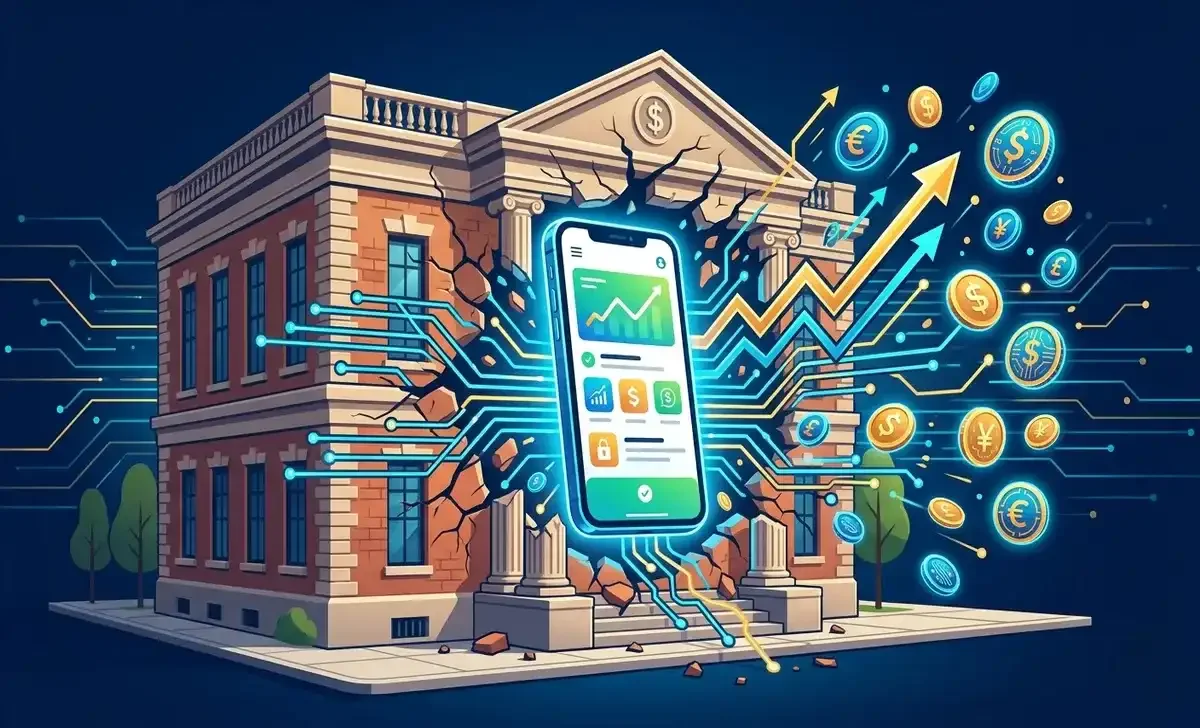
That's exactly why so many entrepreneurs, billionaires, and tech companies are now racing to disrupt US banking. From mobile-first neobanks to AI-powered lending platforms, the financial industry is facing its biggest shakeup since the ATM was invented.
In this article, you'll learn:
- The 10 most powerful forces disrupting traditional banking right now
- Real examples of companies changing the rules
- What these changes mean for your everyday finances
- Expert tips on how to take advantage of the new banking landscape
- Common mistakes people make when switching to fintech alternatives
Let's dig in.
1. The Rise of Neobanks
The first thing that comes to mind when people talk about efforts to disrupt US banking is neobanks — digital-only financial institutions with no physical branches and razor-thin fees.
Companies like Chime, SoFi, Ally, and Current have collectively attracted tens of millions of users. Why? Because they offer what traditional banks don't: no monthly fees, early direct deposit by up to two days, high-yield savings accounts, and a genuinely good mobile experience.
Chime, for instance, doesn't charge overdraft fees at all — it simply declines the transaction or, through SpotMe, covers it up to a limit. That alone is revolutionary compared to the $15 billion US banks collect annually in overdraft fees.
Neobanks aren't technically banks — most partner with FDIC-insured institutions on the backend. But for everyday users, the experience is cleaner, faster, and cheaper.
The bottom line: If you're still paying monthly maintenance fees, a neobank might save you $100–$200 per year without giving up anything meaningful.
2. Embedded Finance Is Eating Banking
You don't need to walk into a bank to get a loan anymore. In fact, you might not even need to visit a banking app.
Embedded finance means financial services — payments, credit, insurance, savings — are being woven directly into non-financial platforms. When you buy a mattress and get offered 0% financing right on the checkout page, that's embedded finance. When your Uber driver gets a no-fee debit card to receive earnings instantly, that's embedded finance too.
Companies like Stripe, Plaid, Unit, and Synapse are building the infrastructure that makes this possible. They allow almost any company — a software platform, an e-commerce site, a gig economy app — to offer banking services without becoming a bank.
This is quietly but powerfully shifting where banking actually happens. And traditional banks are largely asleep at the wheel.
What it means for you: Expect to see credit, savings, and payment features pop up in apps you already use daily — from your favorite shopping platform to your employer's HR portal.
3. AI-Powered Lending Changes Who Gets Credit
One of the most glaring failures of traditional US banking is how it decides who deserves a loan. The FICO score system, which has been the gold standard since the 1980s, is notoriously blunt. It often penalizes people with thin credit files — immigrants, young adults, gig workers — even when they're financially responsible.
That's changing fast.
Startups like Upstart, Zest AI, and Petal use machine learning to evaluate creditworthiness using hundreds of data points: education, employment history, cash flow, spending patterns, and more. Upstart claims its model approves 27% more borrowers than traditional models while maintaining the same default rates.
For lenders, this means less risk and more customers. For borrowers who've been unfairly excluded by the old system, it's a genuine lifeline.
Practical tip: If you've been turned down for a loan by a traditional bank, check AI-first lenders. You may qualify at a significantly better rate than you expect.
4. Blockchain and Decentralized Finance (DeFi)
DeFi is perhaps the most radical attempt to disrupt US banking — because it aims to remove banks from the equation entirely.
Using blockchain technology, DeFi platforms let people lend, borrow, earn interest, and trade assets without any central authority. Protocols like Aave, Compound, and Uniswap operate 24/7, across borders, with no credit checks and no middlemen.
Now, DeFi is not without its serious risks. Smart contract bugs, regulatory uncertainty, and the volatility of crypto assets make it a dangerous space for inexperienced users. The collapse of several high-profile DeFi projects and crypto exchanges in 2022–2023 was a painful reminder.
But the underlying technology — programmable money, transparent ledgers, instant settlement — is genuinely transformative. Even JPMorgan and Goldman Sachs have experimented with blockchain rails for interbank settlement.
Who it's for right now: Financially sophisticated users comfortable with technical and market risk. Not yet a replacement for everyday banking.
5. Real-Time Payments Are Finally Here
For decades, the US lagged embarrassingly behind countries like the UK, India, and Brazil in payment speed. The UK in particular has long been ahead on financial infrastructure — a country where inflation dynamics and monetary policy have shaped a more consumer-forward banking culture. Sending money between different banks could take 2–3 business days. Try explaining that to someone in India who can settle a payment in 10 seconds.
That's changing with the launch of FedNow (Federal Reserve's real-time payment network, launched in 2023) and the expansion of The Clearing House's RTP network. These systems allow banks to send and receive money within seconds, any time of day, any day of the year.
Zelle and Venmo were early approximations of this — but they had limits and didn't run 24/7 in true real-time settlement terms. FedNow is the infrastructure-level fix the US banking system has needed for a generation.
What to look for: Ask your bank if they're connected to FedNow yet. Adoption is growing, and for small businesses especially, faster settlements can significantly improve cash flow.
6. Big Tech's Growing Role in Financial Services
Apple, Google, and Amazon aren't just selling gadgets anymore — they want a piece of your wallet.
Apple Pay Later (though since wound down), Google Pay, Amazon Pay, and Apple Card are all attempts by tech giants to embed themselves in how you spend, save, and borrow. Apple Card, issued in partnership with Goldman Sachs, offers daily cash back and a remarkably clean interface — no fees, no penalty rates.
The deeper play here isn't payments — it's data. Every transaction you make gives tech companies insight into your financial behavior. That data is valuable for advertising, product recommendations, and eventually, credit underwriting.
Traditional banks are deeply uncomfortable with this trend. And they should be. If Apple becomes the interface through which most Americans interact with their money, banks risk becoming invisible back-end utilities.
7. Open Banking and the API Revolution
Open banking is a regulatory and technological movement that forces banks to share customer data — with the customer's permission — with third-party apps through secure APIs.
The UK led the way on this years ago. The US has been slower, but the Consumer Financial Protection Bureau (CFPB) finalized rules in 2024 under Section 1033 of the Dodd-Frank Act that give Americans the right to access and port their own financial data.
This matters because it breaks the "sticky" relationship banks have relied on for years. When your full financial picture — spending, savings, debt — can travel with you to a new provider, switching becomes much easier.
Apps like Copilot, YNAB, and Monarch Money already use open banking connections to give you a unified view of all your accounts. As data portability improves, expect competition between banks to intensify dramatically.
8. The Underbanked Problem — And Who's Solving It
Roughly 5.9 million US households were unbanked in 2021 according to the FDIC — meaning they had no checking or savings account at all. Millions more are "underbanked," relying on costly check cashers, payday lenders, and prepaid debit cards.
This is a massive market failure. And it's being addressed by a growing number of mission-driven fintechs.
Greenwood serves Black and Latino communities specifically. Majority targets immigrants. Cheese focuses on the Asian-American community. Dave and MoneyLion target working-class Americans who live paycheck to paycheck.
These companies aren't just doing good — they're building profitable businesses by serving people the big banks have ignored. This is especially relevant as the rise of high-paying remote work and digital nomad lifestyles creates an entirely new class of workers whose income structures traditional banks were never designed to accommodate. It's one of the most compelling arguments that disruption and inclusion can go hand in hand.
9. Regulatory Pressure and the CFPB's Role
Disruption doesn't just come from entrepreneurs. Sometimes it comes from regulators who force banks to behave differently.
The CFPB has been increasingly aggressive in recent years — cracking down on junk fees, pushing for open banking data rights, and scrutinizing overdraft practices. The agency's moves have already prompted several major banks to voluntarily reduce or eliminate overdraft fees.
At the same time, regulators are carefully watching fintechs themselves. The collapse of Synapse in 2024 — a middleware company that held funds for multiple neobanks — left thousands of customers temporarily unable to access their money, exposing gaps in how fintech-bank partnerships are regulated.
Regulation cuts both ways: it pushes legacy banks to improve while also setting guardrails on how aggressively fintechs can move.
10. Personal Finance Automation and Wealth Democratization
Investing used to be for the wealthy. A full-service brokerage account required thousands of dollars to open, and financial advisors were an expensive luxury.
Today, apps like Betterment, Wealthfront, Acorns, and Robinhood have democratized investing to the point where you can start with $5. If you're exploring this space, a curated breakdown of the best trading apps currently available can help you compare features, fees, and suitability before committing. Robo-advisors automatically allocate your money across diversified portfolios based on your risk tolerance and rebalance it over time — for a fraction of what a human advisor would charge.
This is a profound shift. Wealth-building is no longer a privilege. And as AI continues to improve, the gap between what a $10M client gets and what a $1,000 client gets will continue to shrink.
Expert Tips
- Don't put all your eggs in one fintech basket. The Synapse collapse in 2024 was a wake-up call. Keep your emergency fund in an FDIC-insured institution you've verified directly.
- Use fee comparison tools. Sites like NerdWallet and Bankrate regularly benchmark bank fees so you can see exactly what you're overpaying.
- Stack your tools. There's no rule that says you can only use one financial app. Use a neobank for daily spending, a robo-advisor for investing, and a high-yield savings account for your emergency fund.
- Check FedNow enrollment. Not all banks are enrolled yet. If real-time payments matter to you (especially as a freelancer or small business owner), it's worth confirming before you switch.
- Watch for regulatory changes. Open banking rules under the CFPB are still evolving. Staying informed helps you take advantage of new data portability rights as they go into effect.
Common Mistakes to Avoid
1. Assuming fintech = unsafe Most reputable neobanks and fintechs partner with FDIC-insured banks. Your deposits are just as protected as they would be in a traditional bank — as long as you verify this before signing up.
2. Chasing APY without reading the fine print High-yield savings accounts can be great — but some have requirements: minimum balances, direct deposit thresholds, or time-limited promotional rates. Always read before you move money.
3. Overlooking customer service quality Some neobanks have notoriously poor customer support. If your card is frozen or your account is locked, being unable to reach a human for days is a real problem. Check reviews on Trustpilot and Reddit before committing.
4. Ignoring credit-building features Many modern fintechs offer secured credit cards or credit-builder loans that can help you improve your score over time. If you're not using these, you're leaving value on the table.
5. Moving everything too quickly Switching banks takes time — auto-payments, direct deposit, subscriptions all need to be updated. Set up your new account first, leave the old one open for 60–90 days, then close it cleanly.
FAQs
Q1: Is fintech actually safe for my money?
Yes — with caveats. Look for apps that partner with FDIC-insured banks and clearly state which bank holds your deposits. Avoid platforms that are vague about where your money sits. Up to $250,000 per account is federally insured if the underlying institution is FDIC-member.
Q2: Can a fintech app really replace my traditional bank?
For many people, yes. If you primarily use banking for direct deposit, spending, and savings, a neobank can handle all of that more cheaply. However, for complex needs — mortgages, business loans, notarized documents, safe deposit boxes — a traditional bank may still be necessary.
Q3: What is open banking and how does it benefit me?
Open banking lets you securely share your financial data with third-party apps, giving you more flexibility to switch providers, access better budgeting tools, and shop for better rates. New CFPB rules are making this a legal right for US consumers.
Q4: Why are so many billionaires interested in disrupting US banking?
Because the opportunity is enormous. The US banking industry generates over $500 billion in annual revenue. Fee income alone — from overdrafts, wire transfers, account fees — represents billions that fintech companies believe they can capture with a better product.
Q5: Will traditional banks survive disruption?
Almost certainly, yes — but they'll look different. Large banks have the scale, regulatory licenses, and trust to remain relevant. But their margins will shrink, their fee structures will be forced to change, and they'll increasingly partner with (or acquire) the fintechs that are beating them on experience.