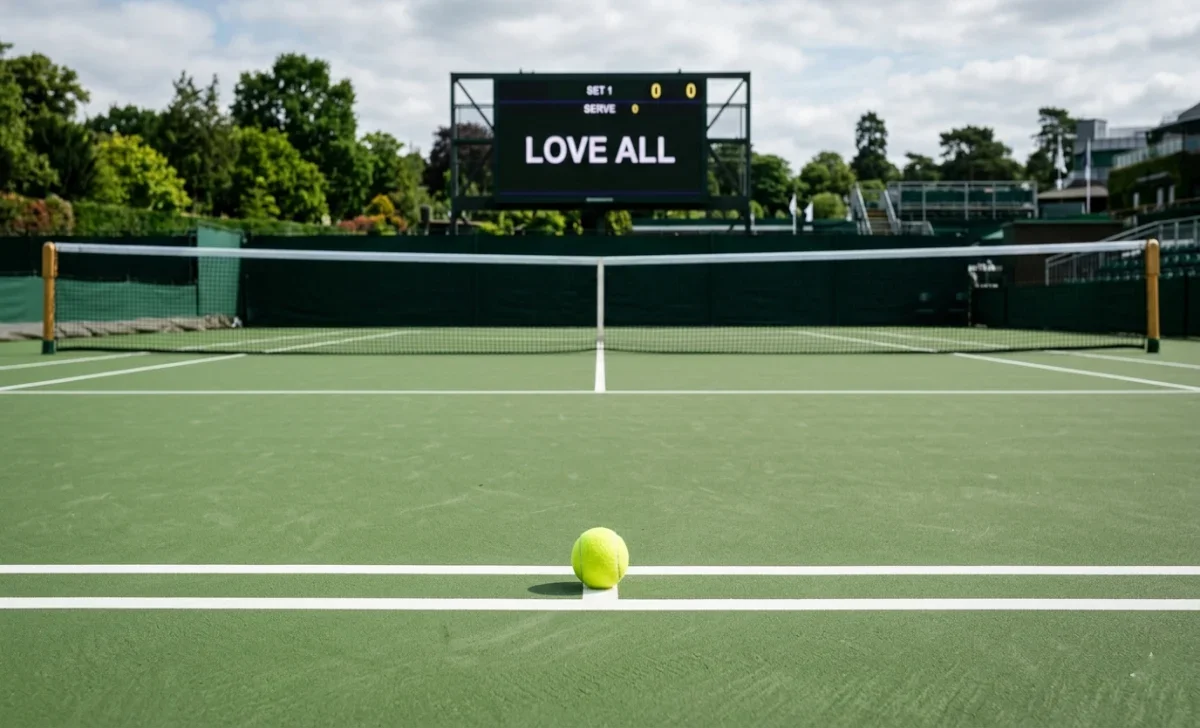
If you've ever watched a tennis match and heard the umpire call out "Love All" before a single ball has been struck, you may have wondered — what does love have to do with sport?
You're not alone. Tennis is one of the few sports where beginners feel immediately lost by the scoreboard. Points don't go 1, 2, 3. They go 15, 30, 40 — and somehow zero is called love. It's odd, it's old, and it's completely charming once you understand it.
This article breaks down everything you need to know about "Love All" in tennis — from its origins and meaning to how the full scoring system works, and why this quirky vocabulary has survived for centuries.
Whether you're a new fan, a casual viewer, or someone picking up a racket for the first time, this guide will help you follow the game confidently.
1. What Does "Love All" Mean in Tennis?
"Love All" is the opening score of every tennis game. It simply means zero to zero — neither player has scored a point yet.
The umpire calls it at the start of each new game within a set. Think of it as the tennis equivalent of saying "0–0" before a football match kicks off.
But unlike football, tennis doesn't just say "zero." It uses the word love to represent a score of nothing. So:
- Love All = 0–0
- 15-Love = server leads 15–0
- Love-30 = receiver leads 0–30
The word "All" is added when both players share the same score. So "30 All" means both players are at 30. "Love All" means both are at zero.
It's one of the first phrases you'll hear at any match, and once you understand it, the rest of the scoring system starts to click into place.
2. The Origin of the Word "Love" in Tennis
This is where it gets interesting. Nobody knows for certain where "love" came from — and that mystery has fueled decades of debate among tennis historians.
The most popular theory is that "love" comes from the French word l'oeuf, meaning "the egg." An egg looks like a zero. Similar to how "duck" in cricket refers to a zero score (also egg-shaped), the idea is that zero on a scoreboard was nicknamed after an egg shape. Over time, l'oeuf may have been anglicized into "love" by English players.
A second theory suggests it comes from the phrase "playing for love" — meaning playing for the enjoyment of the game rather than for money or stakes. If you score nothing, you're still playing for the love of it.
A third theory points to the Dutch word lof, meaning honor or praise, suggesting early players played for pride rather than points.
None of these has been definitively proven. What we do know is that the term has appeared in English tennis records since at least the 18th century and has stayed put ever since. If you want to go deeper into how these traditions took root, the history of tennis heritage — from medieval monastery courtyards to Victorian lawn parties — is a fascinating story in its own right.
3. How Tennis Scoring Works From Love All Onward
Once you grasp "Love All," the full scoring system becomes much easier to follow. Here's how points progress within a single game:
| Score | Tennis Term |
|---|---|
| 0 | Love |
| 1st point | 15 |
| 2nd point | 30 |
| 3rd point | 40 |
| 4th point (wins game) | Game |
So a typical game might be called:
- Love All → 15-Love → 15 All → 30-15 → 40-15 → Game
Why 15, 30, 40 and not 1, 2, 3? One widely cited theory traces this to a clock face — points moved the hand by 15 minutes at a time. The jump from 45 to 40 likely happened to make "deuce" (when both players reach 40-40) easier to call.
Deuce occurs at 40-40. From deuce, a player must win two consecutive points to take the game — first winning "Advantage," then the game point.
4. What Is a Game, Set, and Match?
Tennis is structured in three layers, and understanding them makes "Love All" even more meaningful as a reset signal.
Game: The smallest unit. First to four points (with the two-point lead rule at deuce). Love All starts every game.
Set: First player to win six games wins the set — but they must lead by at least two games. At 6-6, most sets are decided by a tiebreak.
Match: Most professional men's matches are best of five sets. Women's and most other professional matches are best of three sets.
So when you hear "Love All," the umpire is resetting the scoreboard for a brand-new game within a set that could be at any stage of the match. It's a fresh start — both players equal, neither holding an advantage.
5. The Role of the Umpire in Calling Scores
The chair umpire sits elevated above the court and is responsible for announcing every score after each point. Their call is the official record of the match.
After each point, the umpire announces the server's score first, then the receiver's. So if the server leads:
- "15-Love" (server has 15, receiver has 0)
- "30-Love" (server has 30, receiver has 0)
If the receiver leads, you'll hear:
- "Love-15" (server has 0, receiver has 15)
The umpire also handles line call disputes, enforces the rules, and manages time between points. In modern professional tennis, electronic line-calling systems like Hawk-Eye have reduced some of their traditional duties — but the score-calling role remains entirely theirs.
6. Love All in Other Racket Sports
Tennis isn't the only sport to borrow "love" for zero. You'll find the same language in:
Badminton: Historically used "love" for zero in older scoring systems, though the modern rally-point system (up to 21) has largely replaced traditional terminology.
Squash: Some older formats used love-scoring similar to tennis, though contemporary squash typically uses standard numerals.
Table Tennis: Doesn't use "love," but references to the egg-zero connection appear in other sports globally.
Tennis remains the sport where "Love All" is most consistently and universally used at professional, amateur, and recreational levels worldwide.
7. Why Tennis Keeps Its Unusual Scoring
Given how confusing the system can seem to newcomers, why hasn't tennis switched to something simpler — like 1, 2, 3?
A few good reasons:
- Tradition: Tennis is one of the oldest modern sports, with roots going back to 12th-century France. Its vocabulary is part of its identity.
- Atmosphere: Phrases like "Love All," "Advantage," and "Deuce" give tennis a distinct character that fans genuinely love.
- Global recognition: Despite language differences, tennis scoring is universally understood across more than 200 countries.
- Tried and tested: The scoring system creates natural momentum shifts. Deuce and advantage add drama. A simple 0–3 format wouldn't carry the same tension.
Some tournaments have experimented with simplified scoring in exhibition formats. But traditional scoring — starting from Love All — remains the global standard, inseparable from the broader heritage of tennis that has shaped the sport across more than a century of professional play.
8. How to Follow a Tennis Score in Real Time
Watching tennis for the first time can feel like reading a foreign language on the scoreboard. Here's how to decode it quickly:
Step 1 — Watch the umpire's calls. They announce every point. Listen for the score after each rally.
Step 2 — Remember the sequence. Love → 15 → 30 → 40 → Game. It repeats every game.
Step 3 — Track sets separately. The big numbers on the scoreboard represent sets. Small numbers inside are games within the current set.
Step 4 — Note deuce situations. When you hear "Deuce," both players are at 40. The next point gives "Advantage" to one player. Win the following point, win the game.
Step 5 — Use a tennis app. Apps like the ATP Tour, WTA, or Wimbledon's official app display live scores with point-by-point breakdowns — helpful for learning the rhythm.
Expert Tips for New Tennis Fans
- Watch the server's body language. Strong servers thrive on fast surfaces like grass. Knowing who has the serving advantage helps you predict momentum.
- Pay attention at deuce. This is where matches are often decided. A player who consistently wins games from deuce is mentally very strong.
- Learn the surface differences. Clay, grass, and hard courts all favor different playing styles. The same player can look completely different across surfaces.
- Follow one rivalry. Watching a known rivalry (like Djokovic vs. Alcaraz) gives context to every score line. You'll pick up the terminology far faster.
- Don't ignore doubles. Doubles tennis is faster and more tactically interesting than many expect — and the scoring is identical, starting from Love All.
Common Mistakes to Avoid When Learning Tennis Scoring
Mixing up server and receiver scores. Remember — the server's score is always called first. "30-15" means the server leads, not the receiver.
Forgetting the two-game rule in sets. A player doesn't win a set just by reaching six games. They need a two-game lead (unless it goes to a tiebreak).
Assuming all tiebreaks are the same. Standard tiebreaks go to seven points. Some tournaments (including Wimbledon's final set) use a "match tiebreak" to ten points. Always check the format.
Confusing "Advantage" with winning the game. Advantage just means one point ahead at deuce. The player must win the next point too to win the game.
Ignoring the score context. A 40-Love lead sounds comfortable, but tennis is full of comebacks. Three unforced errors and it's deuce.
Conclusion
Love All is far more than a quirky phrase — it's the starting point of every tennis game ever played at any level, anywhere in the world. It signals a clean slate, an equal contest, and the beginning of something that could go in any direction.
Understanding what "Love All" means — and where it came from — opens the door to appreciating the full richness of tennis. Once the scoring makes sense, the drama of deuce, the tension of a tiebreak, and the beauty of a five-set match all land differently.
If you're new to the sport, start by simply listening to the umpire's calls during your next match. The rhythm of the scoring system becomes natural quickly. And the next time you hear "Love All," you'll know exactly what it means and why it's been said that way for hundreds of years. Ready to go deeper? Explore the rich tennis heritage behind the game's grandest traditions, or pick up a racket and experience the score from the baseline yourself.
Frequently Asked Questions
Why do they say "Love All" instead of "Zero Zero" in tennis?
Tennis has used the word "love" for zero since at least the 18th century. The most popular theory links it to the French word l'oeuf (egg), which resembles a zero in shape. It became embedded in the sport's culture long before standardized international rules.
Does "Love All" appear in any other sports?
Historically yes — badminton and some squash formats used similar terminology. But tennis is by far the sport where "Love All" remains most consistently used today at all levels of play.
What happens if the score stays at Love All the whole game?
That would mean no points have been played — which isn't possible in practice. The umpire only calls "Love All" at the very start. Once the first point is played, the score changes regardless of who wins.
Is "Love All" used in both singles and doubles tennis?
The scoring structure — and all its terminology including "Love All" — is identical in singles and doubles tennis. The court dimensions and number of players differ, but the scoring language is the same.
Can a player win a game without the score ever reaching 40?
To win a game, a player must win at least four points. The score progression goes Love → 15 → 30 → 40 → Game. There's no shortcut through the sequence — every game starts at Love All and ends when one player reaches the game point.